
Earlier this year we released the inaugural 2026 Venture Ranking of the top 100 US-based VC firms, followed by the 2026 Biotech Venture Ranking. Both lists are dominated by established firms. Yet some of the most consequential investments of the past decade were made by firms that did not exist ten years ago.
Hi, I’m Ilya. I teach Venture Capital and Private Equity at Stanford GSB, and this is where I publish my research — including the investor rankings — along with materials straight from my Stanford classes.
Today we release the 2026 Venture Ranking of the top 100 US-based Emerging VC Firms, with the extended top 200 ranked as well.
We use the same methodology for all venture rankings. The ranking information cutoff date is June 30, 2026. The full methodology is described in our working paper (Strebulaev and Jackson, 2026), and the 2026 Venture Ranking of Top 100 firms is here:
The 2026 Strebulaev-Jackson Venture Ranking: Complete Top 100 VC Firms

Every founder raising from venture capitalists has heard the same names — Sequoia, Andreessen Horowitz, Benchmark — and every limited partner has a mental shortlist of VC firms that supposedly matter. And while these names are well-known, there, surprisingly has never been a transparent, fully data-driven ranking of which VC firms are actually best at what they do.
How we define an emerging VC firm
For the emerging VC firm rankings, we apply the same methodology as in our overall ranking, but we further restrict the set of eligible firms to include only firms that were founded in 2016 or later and raised their first fund in 2016 or later.
Every other criterion is unchanged. Firms must be institutional US VC firms and must have invested in at least five unique companies via qualified VC rounds and have at least one partner who earned at least five points. We do not restrict eligibility by fund size, team size, or sector: a firm founded in 2016 that now manages fifteen billion dollars is emerging by this definition, and so is a solo general partner running a fifty-million-dollar vehicle.
One point deserves emphasis. This is a ranking of firms early in their institutional life rather than a ranking of small funds or new funds. Some are already very (!) large.
What the score measures
Our algorithm rests on the same six economically grounded factors as in the overall rankings. If you've already read this in our previous articles, feel free to scroll down to the results :)
Valuation. Two companies can both be “worth $100 billion”: one as a public market capitalization, the other as a private post-money valuation. These are not the same number. Private post-money valuations systematically overstate true value, because the preferred stock VCs buy carries downside protections that common stock lacks. We discount private valuations uniformly. My work with Will Gornall put the average overstatement for unicorns near 50%.
Dilution. A 10% stake at the first round is not a 10% stake at exit. Two companies can both sell for $1 billion, but if one raised four rounds along the way, its early investors were diluted round after round. We track each investment’s ownership down through every subsequent round.
Net profit. Net profit is more informative than gross profit when investors deploy very different amounts of capital. Turning $10 million into $2 billion is a different achievement from turning $1 billion into the same $2 billion. We subtract the cost of every investment, which rewards capital efficiency and penalizes spraying large checks to produce a few headline wins. In our data, roughly three-quarters of investments returned negative net profits.
Value add. Investors who lead rounds and take board seats contribute more than passive check-writers. We award additional points for these roles, reflecting involvement in a company’s outcome.
Human-capital decay. A VC’s skill, network, and judgment depreciate if not continuously exercised. We discount each investment by the time elapsed since it was made, using a half-life of three years. A dollar of value created in 2022 is worth about fifty cents in 2025 and a quarter if it was created in 2019. Two investors who each turned a 20% stake into a $10 billion IPO can look identical on paper. Yet if one invested in 2005 and the other in 2020, the second earned an IRR of 141.9% against 28.7%, and rests on human capital six years old rather than twenty-one. This is what keeps the ranking current: it rewards investors who are good now rather than those resting on a single brilliant bet from two decades ago.
Credit between firm and individual. In principle, the points given to each firm are equal to the sum of the points awarded to its partners. However, investors move between firms. When a partner who made their best deals at one firm decamps to another, both firms deserve some credit. We split it: a quarter to the firm where the investment was made, three-quarters to the firm where the partner works now, reflecting academic evidence that most return variation traces to individuals rather than institutions. This is also part of why a firm’s score and its partners’ individual scores can diverge sharply.
Every point still traces back to a specific investment in a specific company on a specific date. The full methodology is in the whitepaper, linked here.
2026 Top Emerging VC firms
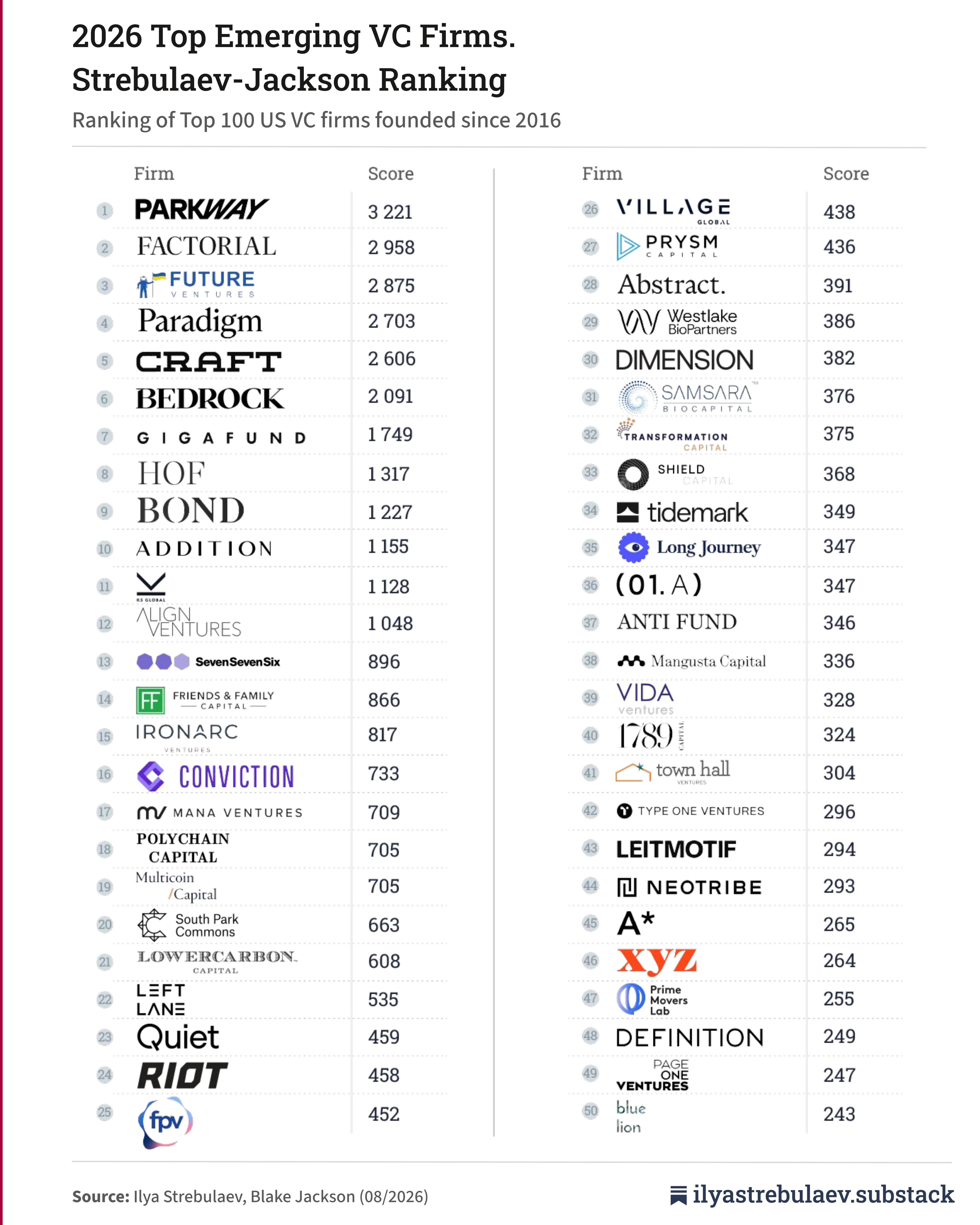
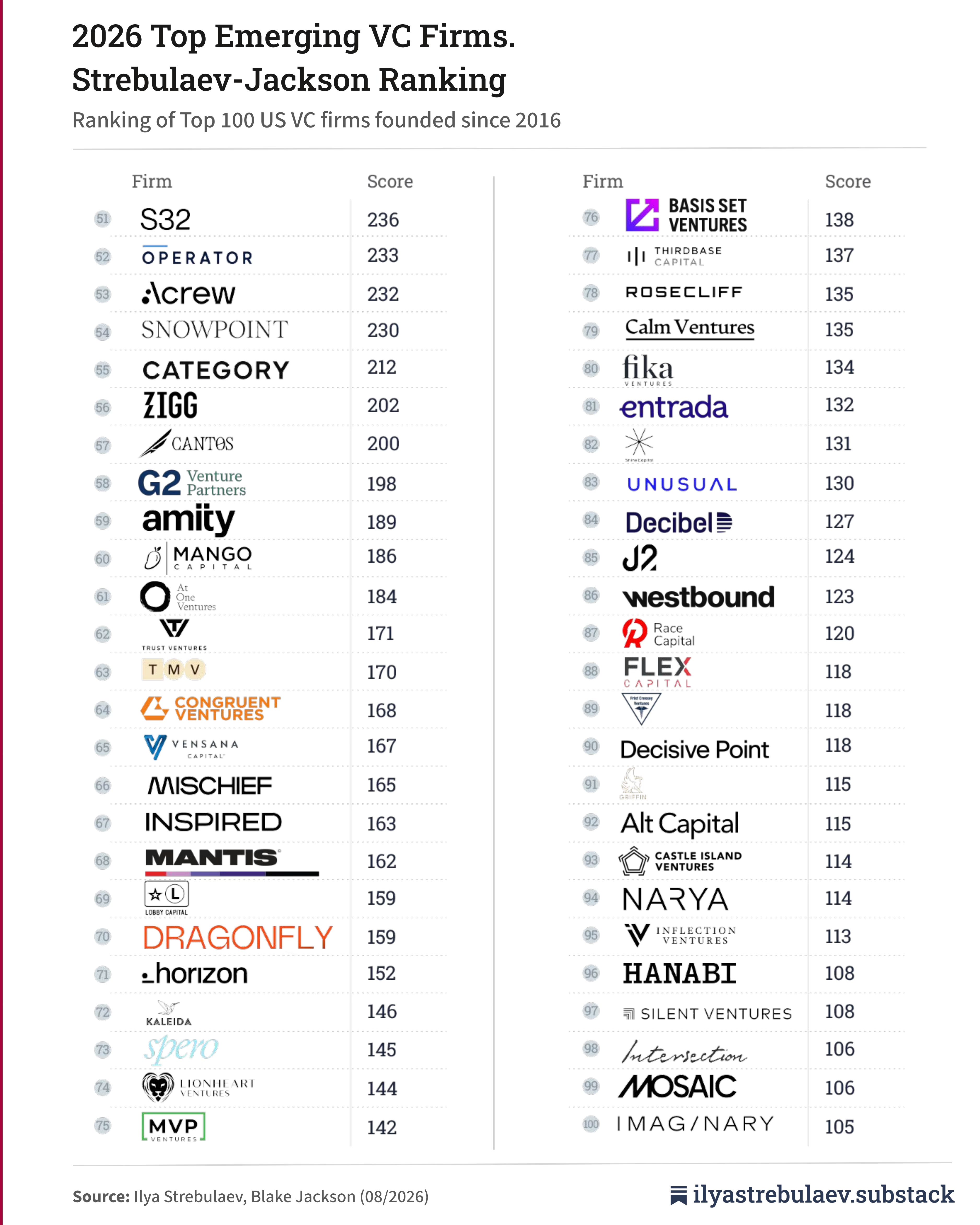
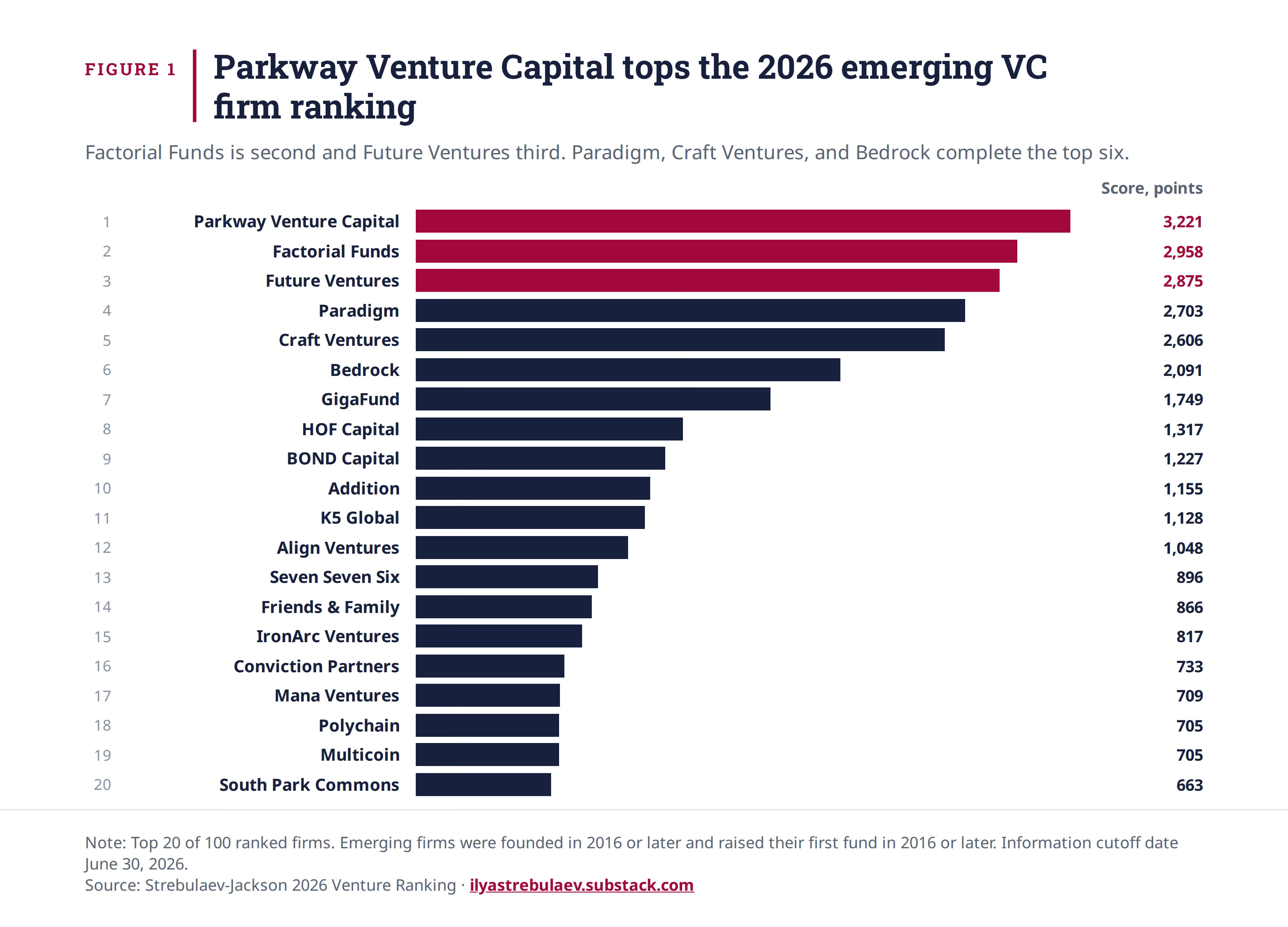
Parkway Venture Capital tops the emerging VC firm ranking with 3,221 points. Factorial Funds is second with 2,958 and Future Ventures third with 2,875. Paradigm, Craft Ventures, and Bedrock complete the top six, followed by GigaFund, HOF Capital, BOND Capital, and Addition in the top ten.
The shape of this curve differs from that in our other rankings. The top is unusually flat: the first six firms are hardly distinguished from each other, and the leader scores only 2.8 times the tenth-ranked firm. In biotech, the top firm scores 5.3 times the tenth. Then it falls away sharply: by rank 25 the score is 452, by rank 50 it is 243, and by rank 100 it is 105. The top firm scores 31 times the hundredth. By comparison, in our overall ranking, the top firm scores about 41 times the hundredth. The top ten account for 45% of all points in the top 100, and the top five for 30%.
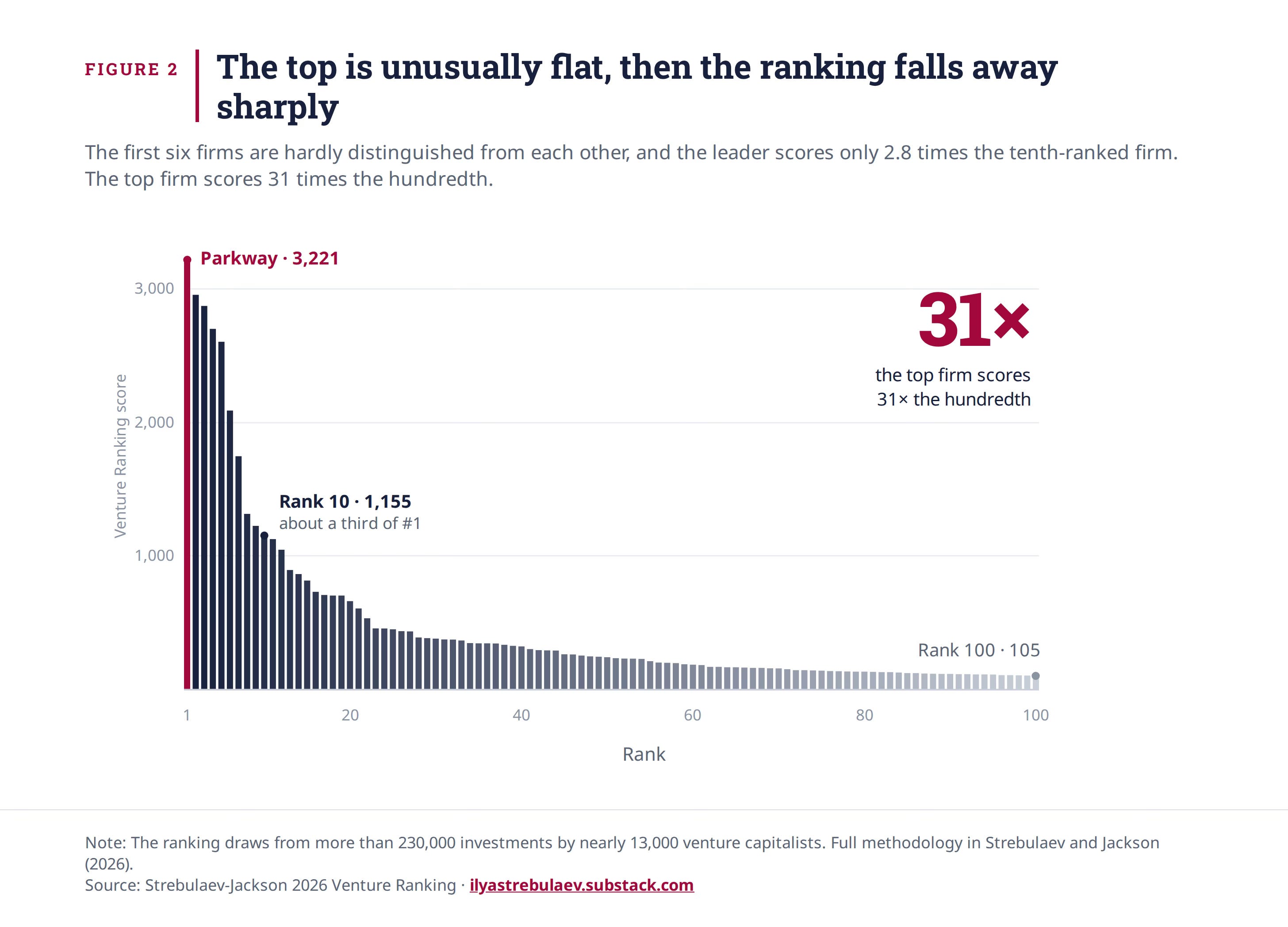
Beyond the top 100, the list flattens further still: the extended ranking runs from 105 points at rank 101 down to 31 at rank 200, a range narrower than the gap between this list’s first and second firms.
The flat top underlines the difference between emerging VC firms and more mature firms. Among established firms, the leaders separate themselves over decades of compounding. Among emerging VC firms, a handful of firms each have partners who caught one or two of the same extraordinary companies, and they arrive at similar scores by different routes.
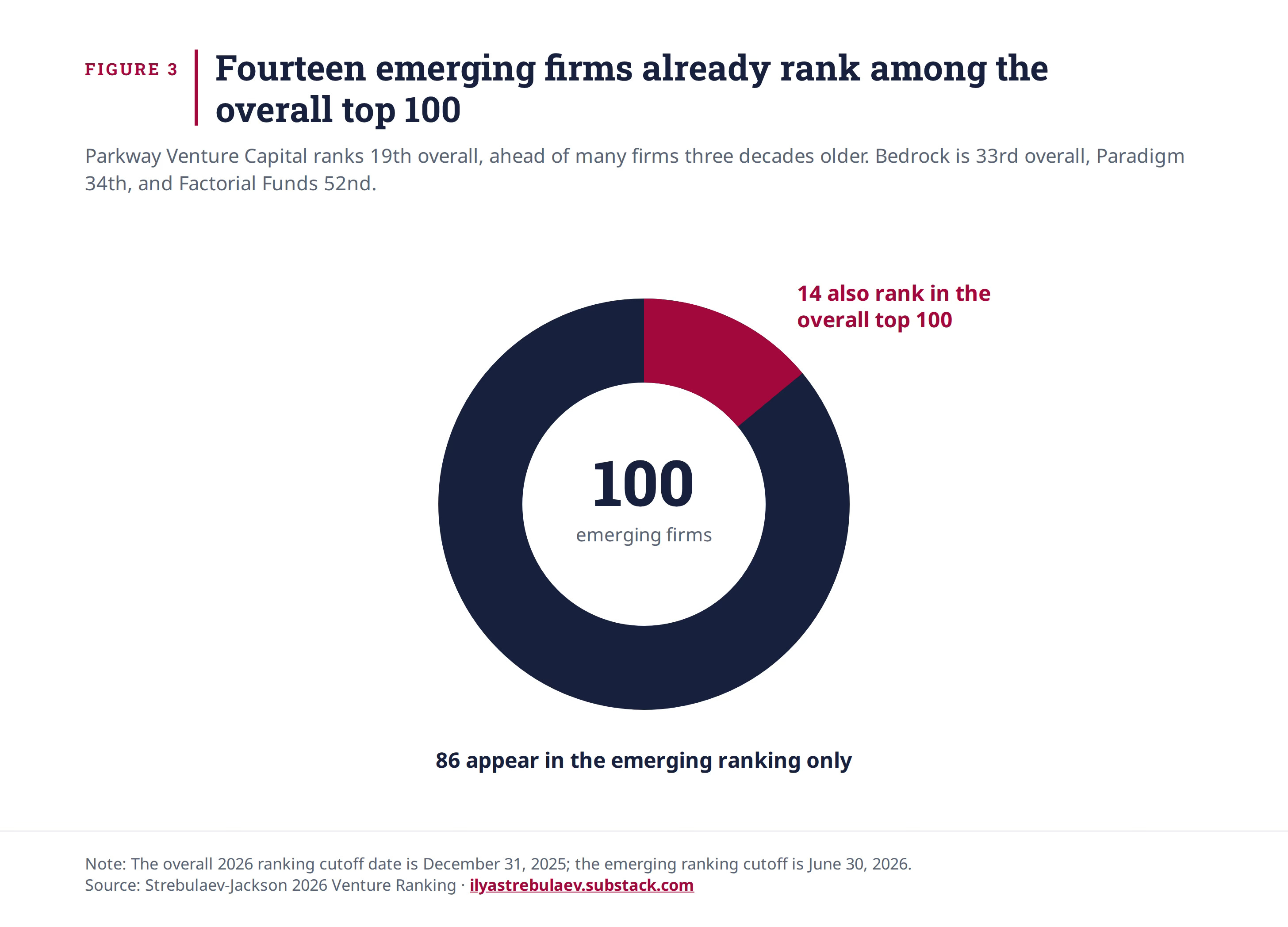
Fourteen Emerging Firms Already Rank Among the Overall Top 100
One striking result is how far these firms have already climbed on the overall list. Fourteen of the emerging top 100 also appear in our overall 2026 ranking of all US VC firms.
Parkway Venture Capital ranks 19th overall, ahead of many firms three decades older. Bedrock is 33rd overall, Paradigm 34th, Inflection Ventures 42nd, Factorial Funds 52nd, Future Ventures 57th, and Addition 64th. Further down: Multicoin (84th overall), Neotribe (87th), HOF Capital (88th), Craft Ventures (93rd), Polychain (95th), and Zigg (100th). A firm founded after 2016 competing with Sequoia and Benchmark on the same table would have been a rare unicorn in any prior venture cycle. (Note: our 2026 overall ranking cutoff date is December 31, 2025.)
The First-Fund Vintages Tell a Story About the 2016–2021 Window
Fifty-four of the top 100 raised a first fund between 2016 and 2019, with 2018 the single largest vintage at 21 firms. A second cluster of 19 firms raised in 2021, at the peak of the last cycle. The 2022–2026 vintages contribute only 17 firms combined. A 2025 first-time fund has had almost no time to generate returns.
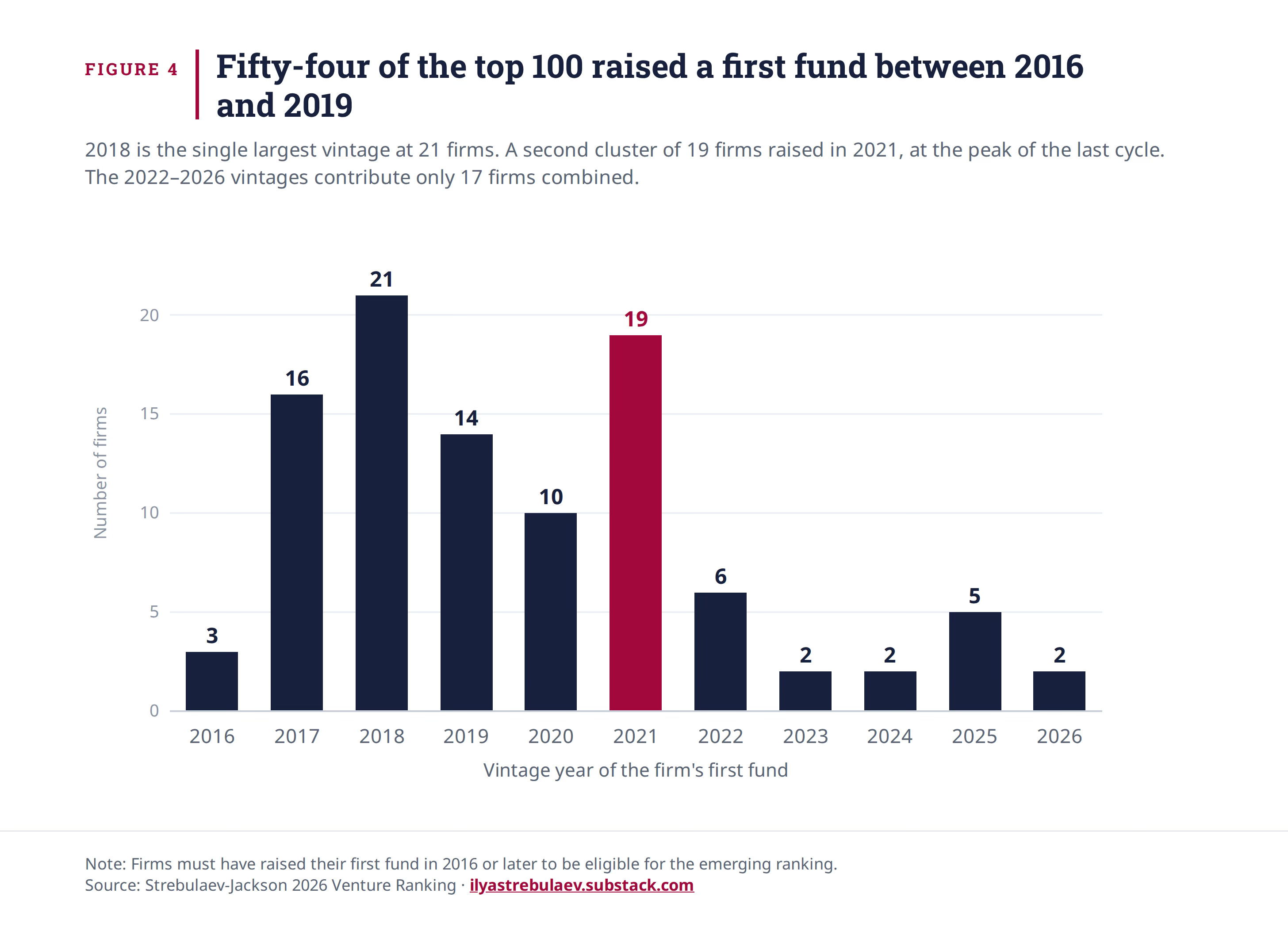
A few very new firms have broken through anyway. IronArc Ventures raised its first fund in 2024 and ranks 15th. Anti Fund (2025) is 37th, Mangusta Capital (2024) is 38th, and 1789 Capital (2025) is 40th. Kaleida and Inflection Ventures both carry 2026 first-fund vintages and still make the list, at 72nd and 95th. These are firms whose partners brought track records with them rather than building from zero, a direct consequence of our three-quarters credit rule that allows points to follow a partner between firms.
The Dominance of AI in the Ranking
For 33 of the top 100 firms, the highest-scoring investment is an AI company. xAI alone is the top position for ten different firms; Anthropic for five; Baseten for four; OpenAI, Together AI, Databricks and Code Metal for two each; Fal, Mercor, Groq, d-Matrix, Suno and Mind Robotics for one each.
A further 15 firms are anchored by defense, space, energy or nuclear companies: SpaceX (three firms), Anduril, Shield AI, Neros, Valar Atomics, Standard Nuclear, Venus Aerospace, Crusoe, Fervo Energy, Base Power, Fuse Energy and Harbinger. Fifteen are anchored by crypto or fintech, including Kalshi, Polymarket, Circle, Hidden Road, Revolut and Chime. Eleven are anchored by biotech or health companies. Only 26 of the top 100 rest on conventional software or consumer businesses.
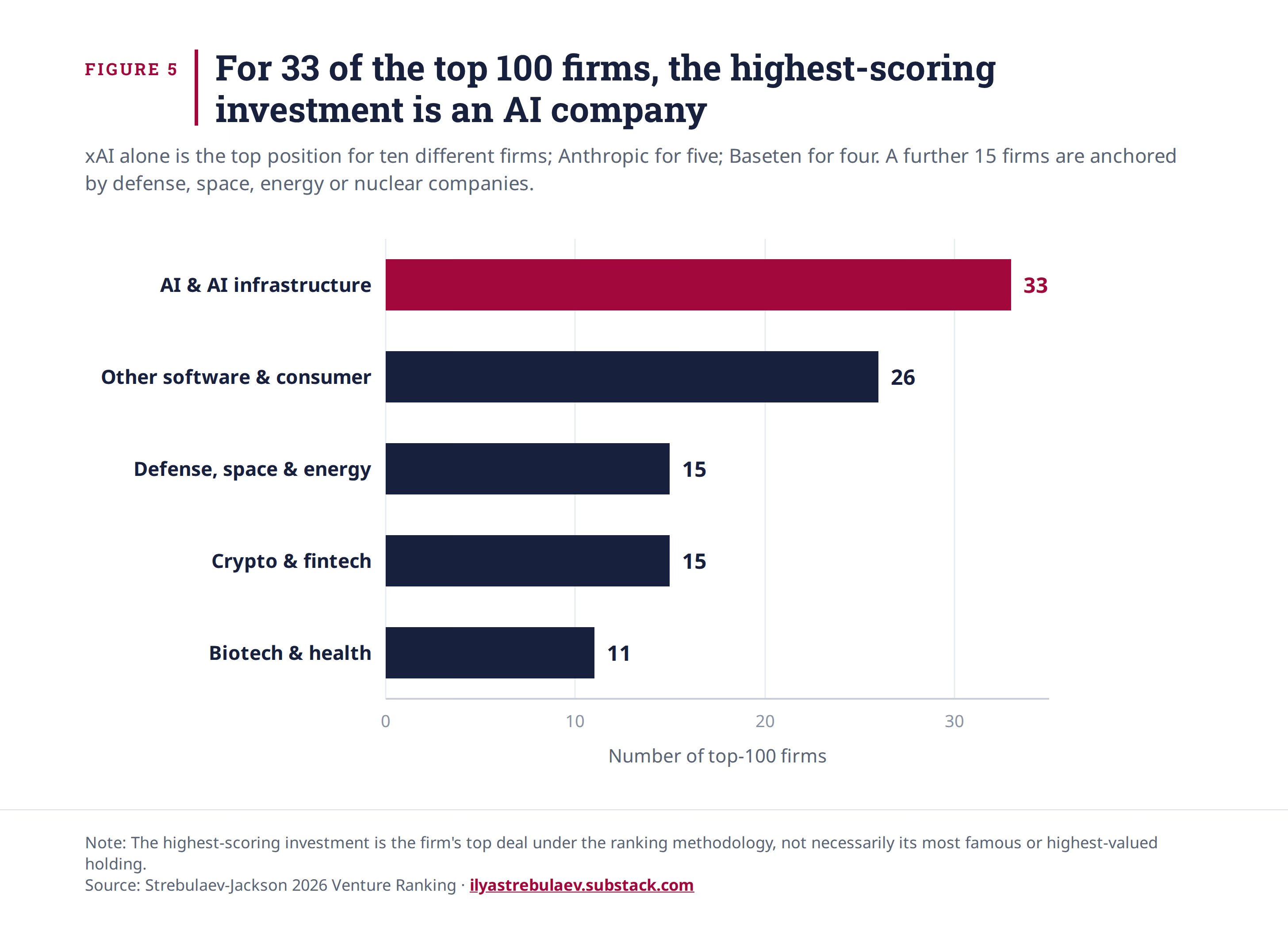
The extended ranking looks quite different. Among firms ranked 101–200, not one is anchored by xAI, Anthropic or OpenAI, and no single company is the top position for more than two firms. The AI factor is concentrated almost entirely in the first hundred.
Compare this with our overall ranking, where 23 of the top 100 firms owed their top position to a frontier-AI or AI-infrastructure company, and with biotech, where nine of the top 50 did. Emerging VC firms are more concentrated in the AI cycle than the established industry is. Whether that reflects better positioning or greater exposure to a single correlated bet is an open question.
Recent Investments Matter More
Half of all points earned by the top 100 come from investments made in 2023 or later. Only 4% come from before 2015. Forty-seven firms draw more than half their score from the 2023-and-later window, and 32 draw more than three-quarters of it.
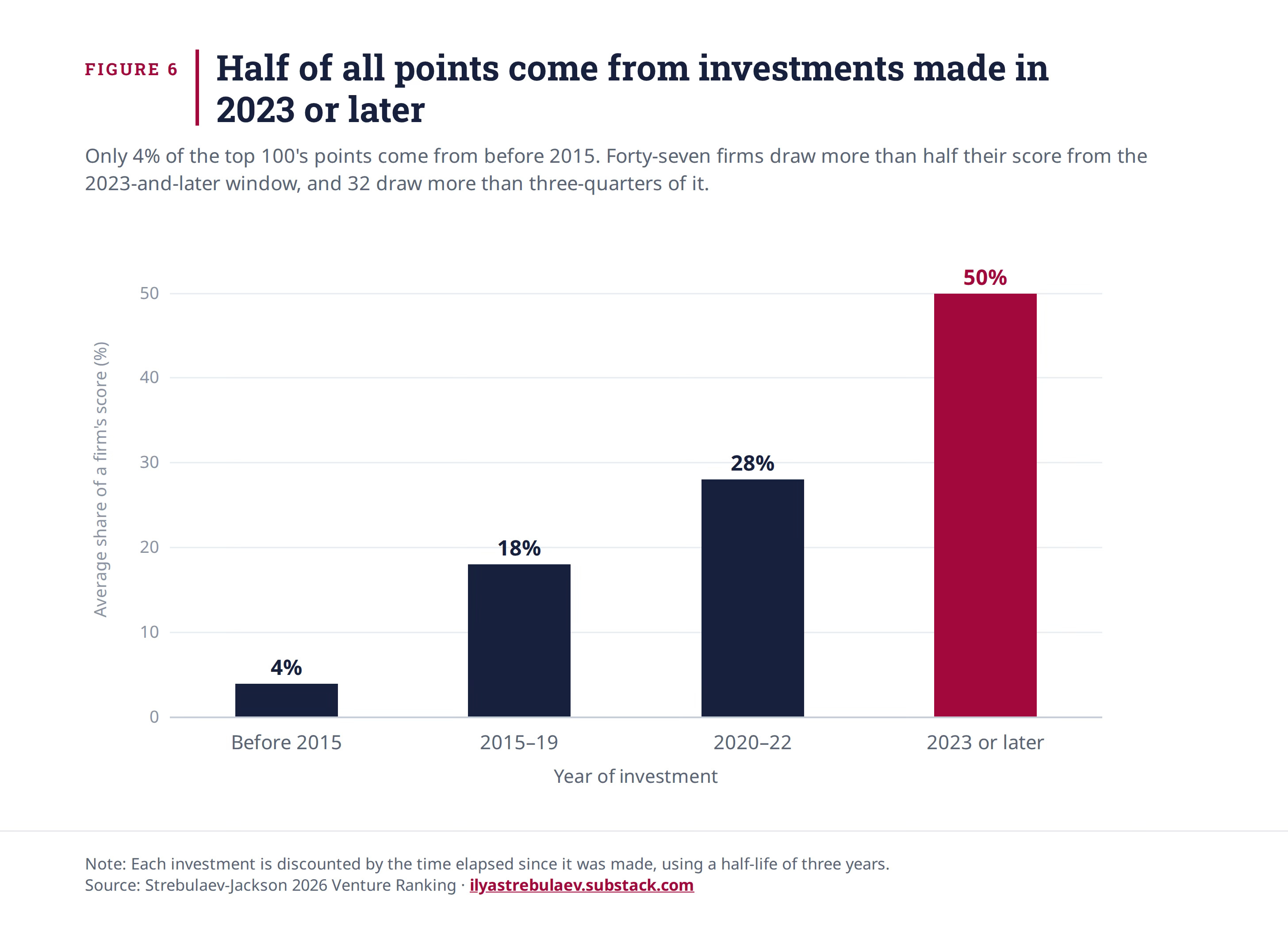
The second hundred is markedly less recent: firms ranked 101–200 draw 32% of their score from 2023 or later against 50% for the top 100, and 27% from 2015–2019 against 18%. The newest value sits at the very top of this ranking.
An important caveat is that emerging VC firms are being scored almost entirely on investments that are still unrealized.
Outcomes are extraordinarily concentrated
Across the top 100 firms there are 73 distinct highest-scoring companies, and the concentration at the top is severe. Ten firms owe their top position to xAI and five to Anthropic, meaning 15% of this ranking traces back to two companies. Add Baseten, SpaceX, Revolut and OpenAI and the figure reaches 27%. This is a higher concentration than in either the overall or the biotech ranking.
For the extended ranking, among firms 101–200 there are 90 distinct highest-scoring companies for 100 firms.
Small teams, and often small funds
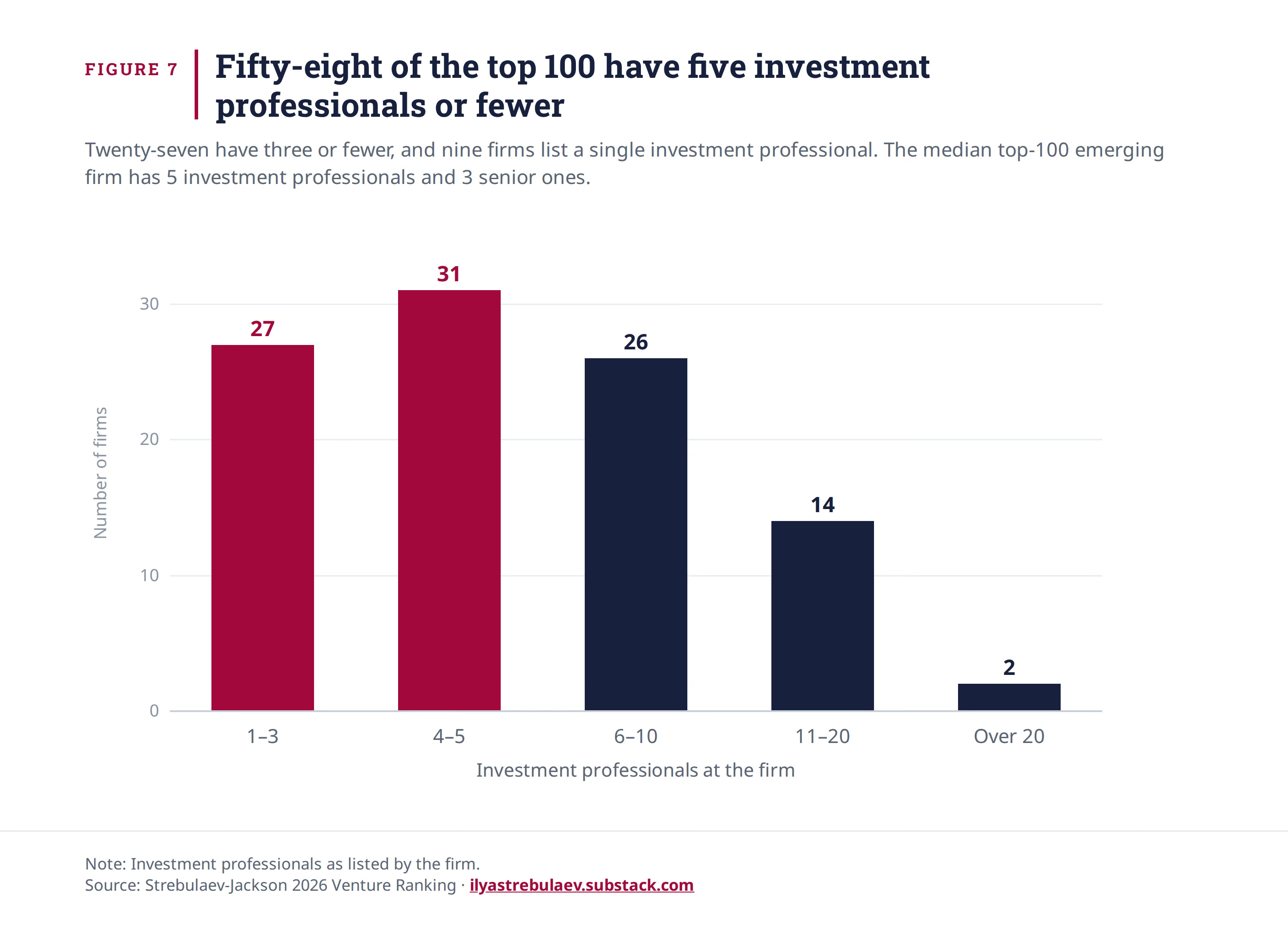
Fifty-eight of the top 100 firms have five listed investment professionals or fewer, and 27 have three or fewer. Nine firms in the top 100 list a single investment professional. The median Top 100 emerging firm has 5 investment professionals and 3 senior ones.
Fund sizes vary enormously. Median reported assets under management are about $840 million, but the range runs from GigaFund at roughly $15 billion and Paradigm at $11.9 billion down to Page One Ventures at $5 million (49th), Decisive Point at $11 million (90th), Castle Island at $22 million (93rd) and Kaleida at $25 million (72nd). Twenty-four firms in the top 100 manage under $250 million and ten manage under $100 million. Because the score rests on net profit, value created minus capital deployed, a concentrated small fund can outscore a multi-billion-dollar platform, and here several do.
Fund sizes fall away sharply outside the top 100. Median reported assets under management in the 101–200 band are about $240 million, well under a third of the $840 million median of the top 100.
Geography: The Same Map as the Overall Ranking, Plus Florida
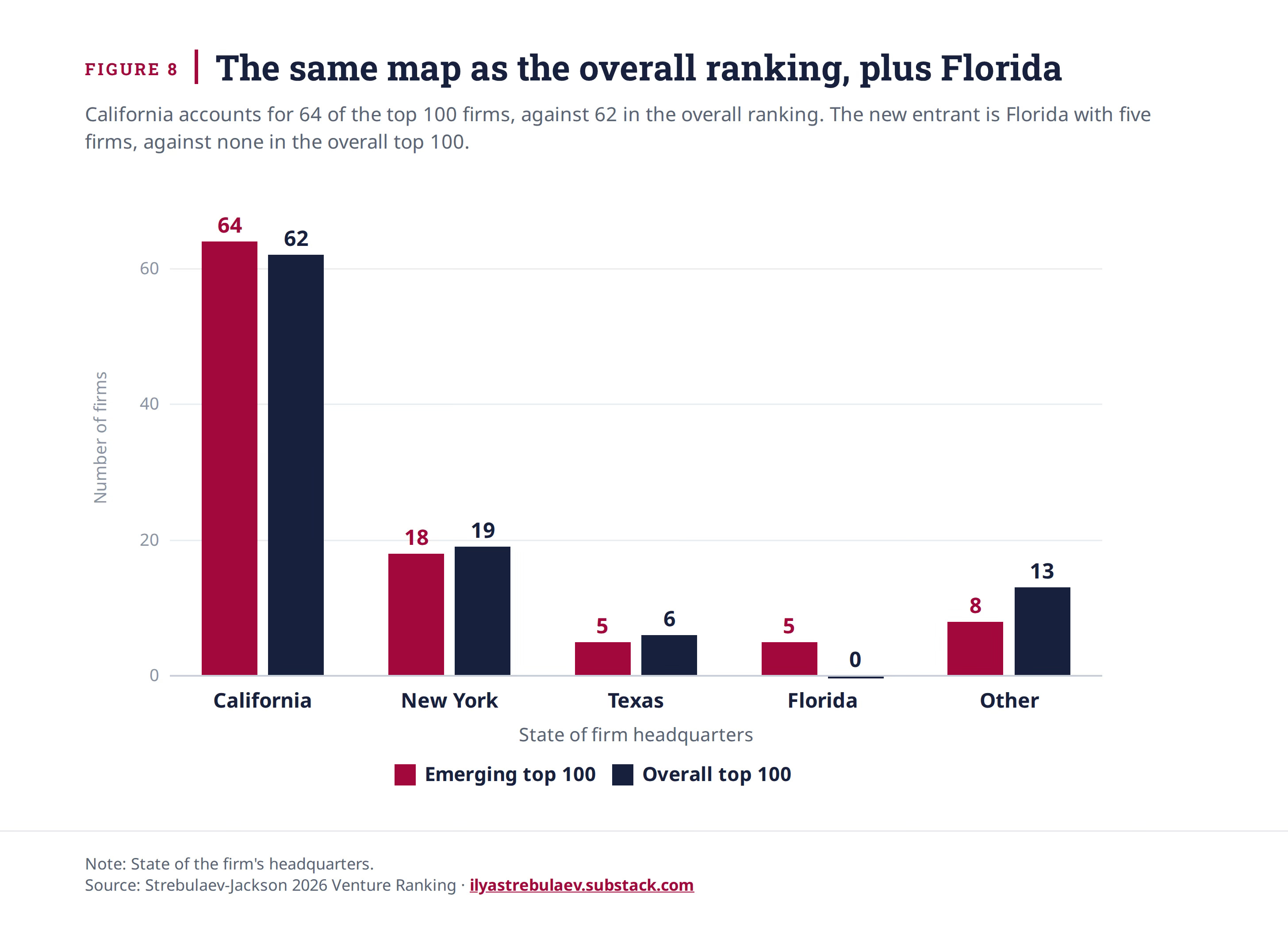
California accounts for 64 of the top 100 firms, against 62 in the overall ranking, essentially unchanged. Fifty-one are in the San Francisco Bay Area, 31 of them in San Francisco itself. New York is second with 18 firms, and Texas third with 5, concentrated in Austin.
The new entrant is Florida, which contributes five firms to the emerging top 100: Align Ventures (12th), Anti Fund (37th) and Horizon Venture (71st) in Miami, 1789 Capital (40th) and Snowpoint Ventures (54th) in Palm Beach, against none in the overall top 100. Massachusetts, by contrast, is thinly represented: just three firms, Transformation Capital (32nd), J2 Ventures (85th) and Castle Island (93rd), against six in the overall ranking and thirteen in the biotech top 100. The rest are scattered singly across New Jersey, Wyoming, Minnesota, Tennessee, Ohio and Colorado.
The 2026 Emerging VC Firm Ranking: the Top 100 Firms
The link below gives additional information about the Top 100: location, number of partners, recent activity, etc.