
Earlier this year we released the inaugural 2026 Venture Ranking of the top 100 VC firms, followed by the top 50 biotech VC firms and top 100 Emerging VC firms. AI already stood out in the overall ranking. For nearly a quarter of the top 100 firms, the single highest-scoring investment was a frontier-AI or AI-infrastructure company.
Today we release the 2026 Strebulaev-Jackson AI Venture Ranking of the top 50 VC firms. It scores VC firms only on their investments in US-based AI companies. Every point in this ranking comes from an AI company.
We use the same methodology for all venture rankings. The cutoff date for this ranking is August 31, 2026. The full methodology is in our working paper (Strebulaev and Jackson, 2026). The 2026 Venture Ranking of the top 100 VC firms is here.
The full ranking of 100 AI VC firms and the interactive Airtable with the data behind every score are already available to Paid members as my thank you for their support.
You can upgrade now to get immediate access.
Paid & Founding members will unlock valuable insights for founders and VCs:
The 50 most successful investors in AI companies, plus the firms ranked 51–100
Who are the AI specialists, the firms that earn more than 90% of their total score from AI
The AI score, the distribution of AI scores by recency, and the number of investment professionals for every one of the 50 firms
Here is a sneak peek at the Airtable.
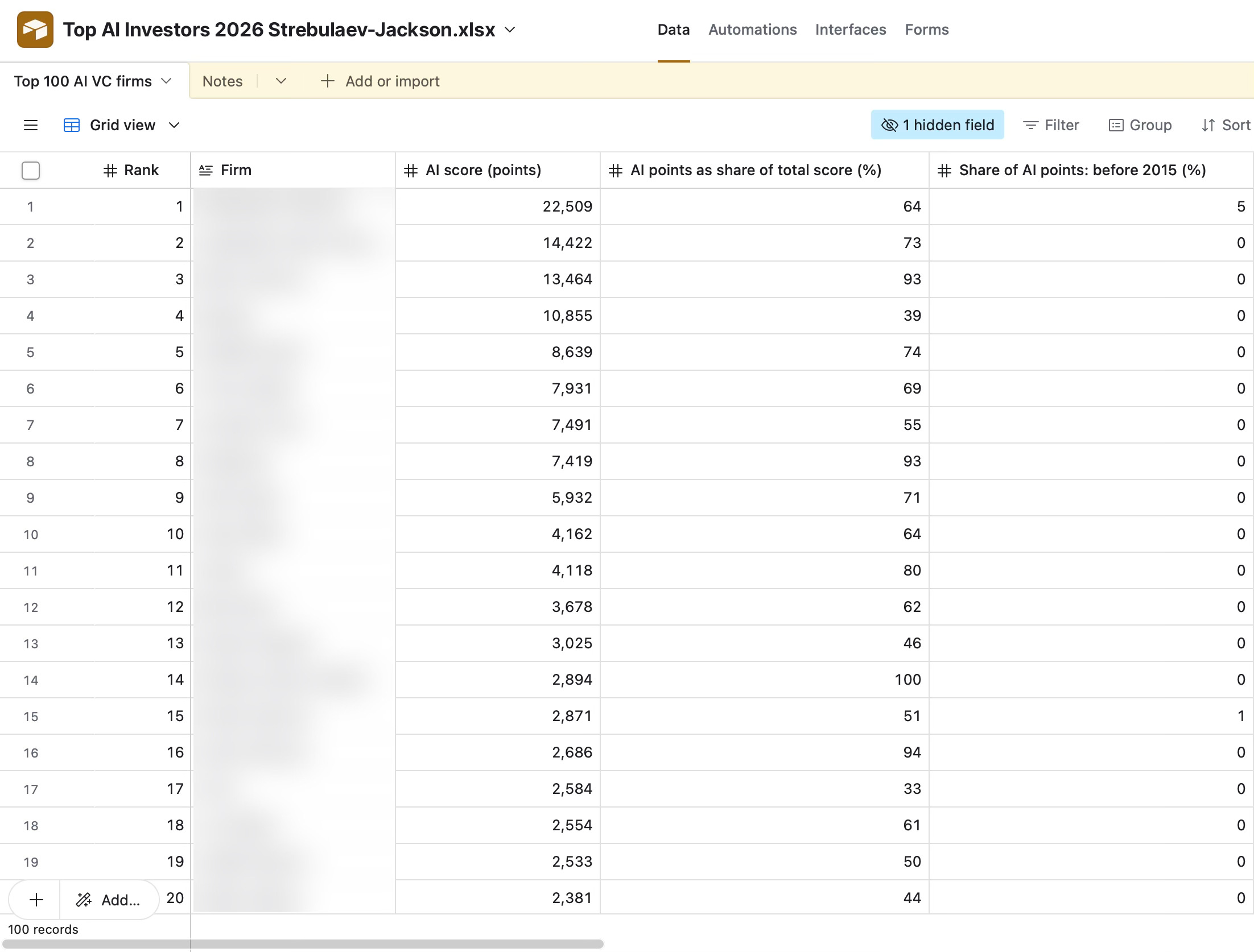
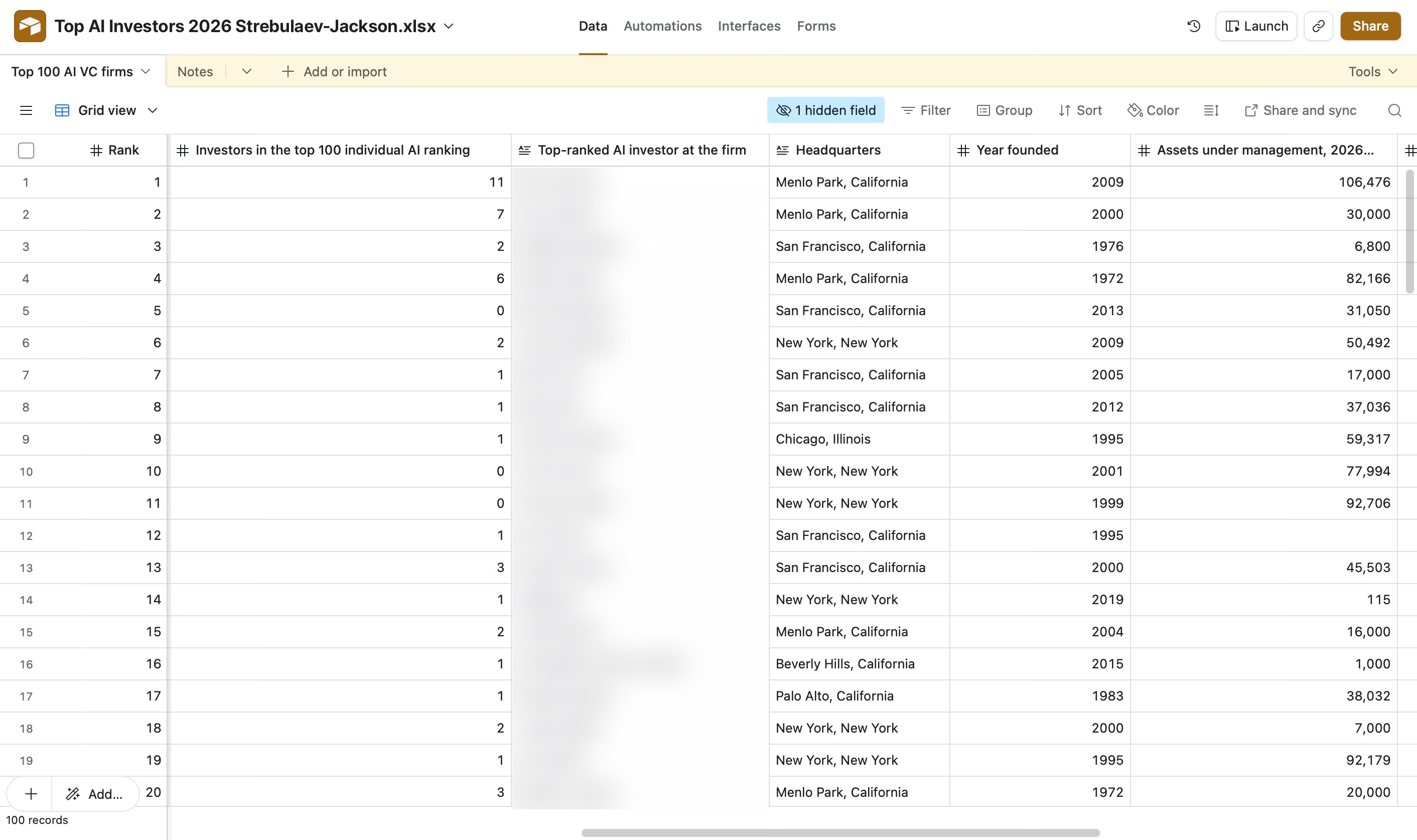
A paid subscription covers more than this ranking. It also gives you every other ranking we publish in full, with up to 200 more investors scored in each; our proprietary data on the top VC and angel investors and on unicorns; the cheat sheets from my Stanford VC and PE classes; and fundraising guides from first outreach to deal terms.
AI is now most of venture
AI now dominates US venture capital. So which investors actually created value in AI? For a founder building an AI company, the answer helps decide whose money to take. For a limited partner, it helps separate managers with real AI track records from managers with AI in their pitch decks (and gives the managers themselves a benchmark).
The question is harder to answer for AI than for venture overall. Most AI value is recent and still unrealized, and a small number of companies account for much of it. Brand names in venture are no reliable guide to AI performance, either.
As I show below, some of the best-known firms in the industry rank far lower in AI than their overall reputation would suggest. A transparent, data-driven AI ranking fills that gap.
Defining an AI company is non-trivial
To rank AI investors, we first need to decide which companies are AI companies. This is not easy and often subjective. Almost every startup now mentions AI in its pitch, and databases tag companies as AI generously. As a result, we spent a lot of time on AI classification of VC-backed companies.
In addition to subjectivity, timing is also important. Alphabet could be an AI company now, but its predecessor Google was not when it was a VC-backed company. We are interested, for our ranking, only at the time when the companies were private and raised VC money.
Some industry sources are generous in classifying AI companies. PitchBook, a high-quality source of investments in VC-backed companies, for example, tags companies with an “Artificial Intelligence & Machine Learning” vertical. In the PitchBook sample of US-based VC-backed companies founded between 2015 and today, 20,461 companies, about a third, carry this tag. Of the tagged companies my team reviewed by hand, more than half are not AI by our definition. Navan, a corporate travel platform that describes itself as AI-powered, is one example of a company that carries this tag, but that we don’t classify as AI.
Before I provide our AI classification rules and process, let me emphasize: you may disagree with some of our definitions and classifications and there are some grey cases where the reconciliation was not obvious. Given the way our ranking methodology works, our overall ranking is robust as long as we agree on the classification of top companies. But I am sure we will be getting many comments and making adjustments in the future.
The removal test: would the product survive without AI?
To classify VC-backed companies, we start by asking what role AI plays in the product. A company is an AI company if AI is the product itself, or the core mechanism through which the product delivers its value, and the company develops it in-house. A company that builds infrastructure specifically for developing or running AI also counts.
Our main tool is a simple thought experiment. Strip the AI out of the company. Does the product still exist as something customers buy? If yes, the company is not an AI company. If the product collapses, it is.
OpenAI, Deepgram (a speech-recognition engine) and Figure AI (humanoid robots) pass easily. Remove the AI and nothing is left to sell. Lemonade, on the other hand, describes itself as an artificial-intelligence-based platform, but it sells insurance. Upstart sells loans, SeekOut sells recruiting and Sprinklr sells customer-experience software. AI makes each of these products better, but the product is still the policy, the loan, the hire or the campaign. We classify all four as non-AI. As a rule, “AI-powered” (as opposed to “AI-native”) fintech, insurtech, HR, marketing and travel companies do not count.
AI infrastructure counts
Some companies sell the picks and shovels for AI rather than AI itself. We count them when the infrastructure exists specifically to build or run AI. Examples include chips designed for AI (SambaNova, Cerebras), machine-learning platforms (Anyscale, Baseten), GPU clouds for training and inference, and data labeling (Scale AI).
We do not count general-purpose infrastructure that merely also hosts AI workloads. Render, a general cloud platform, does not qualify. Neither does Frore Systems, which makes cooling chips for AI devices.
The grey zones: robotics, automation and “wrappers”
Robotics. A robotics company counts when autonomy is the point, as with humanoid and cognitive robots such as Figure AI and Dexterity. Fixed-program industrial automation does not count.
Self-driving. Companies that build the autonomy stack or perception software count. Companies that make navigation hardware, digital maps or braking components without machine learning do not.
Quantum computing. QuEra is deep tech, but it is not AI. Quantum companies count only if their product is explicitly quantum machine learning.
Automation software. Automation tools count only where machine learning is core, such as document understanding or computer vision on screens. UiPath qualifies. Rule-based workflow tools do not.
Wrappers. Many new products run on third-party foundation models accessed through an API. If the AI is the product itself, as with an assistant, an agent or a copilot, the company counts, because it fails the removal test. If the third-party AI merely garnishes a conventional product, it does not count. This is the classification category most likely to move as the category matures.
Pivots. Company descriptions can predate a pivot. Where a company has clearly pivoted, we classify its current business as long as it took place when it still was a VC-backed company. Turing, for example, moved from software staffing to AI infrastructure. Vague pivot language alone does not qualify.
Our list of AI-classified companies is smaller
Our classification process has several stages. Once we automatically remove the cases that obviously do not qualify, each company is reviewed by an AI agent and then by two independent human analysts, with a third human researcher reconciling any remaining differences.
This manual process is slow and costly. We manually classified every unicorn and every company with at least 50 points in the Strebulaev-Jackson rankings. Companies that are under 50 points are much less likely to move even the tail of the ranking. In total, we reviewed 2,254 companies and classified 706 of them as AI. Thank you to the entire team including Yana Pavlovskaya, Alexei Ostapolets and Umid Abdunabiyev for their work on the process.
Who qualifies for the ranking
The eligibility rules for VC firms are the same as for our overall ranking, applied to AI. Firms must be institutional asset managers with venture capital investment activity. We include growth equity and private equity firms that invest in VC-backed companies. We exclude accelerators, angel groups, corporate VCs and family offices unless they have raised outside LP capital.
Only qualifying rounds count: Angel, Pre-Seed, Seed, Early-Stage VC and Later-Stage VC. Secondary transactions do not. Only investments in US-headquartered AI companies count, but the VC firm itself can be based anywhere. A firm must have invested in at least five distinct US AI companies, must have made at least one qualifying investment in the five years before the cutoff, and must have at least one identified investment professional. The cutoff is August 31, 2026.
We publicly release the Top 50 AI VC firms. We rank the Top 100, and the analysis below covers all 100 firms. The 51-100 ranking is given to paid and founding subscribers.
We use the same six factors in our rankings
Our ranking score rests on the same six factors as all our rankings:
1. Valuation
2. Dilution
3. Net profit
4. Value add
5. Human-capital decay
6. The split of credit between firms and individuals.
These factors are objective, transparent, and replicable. See here for details.
Andreessen Horowitz leads the AI ranking by a wide margin
Andreessen Horowitz tops the AI ranking with 22,509 points, about 1.6 times the score of Lightspeed Venture Partners, which is second with 14,422. Menlo Ventures is a close third with 13,464. Sequoia (10,855) and ICONIQ Growth (8,639) complete the top five. Thrive Capital, Founders Fund, Dragoneer, Valor Equity and Tiger Global complete the top ten. Figure 1 shows the top 50 AI VC firms.
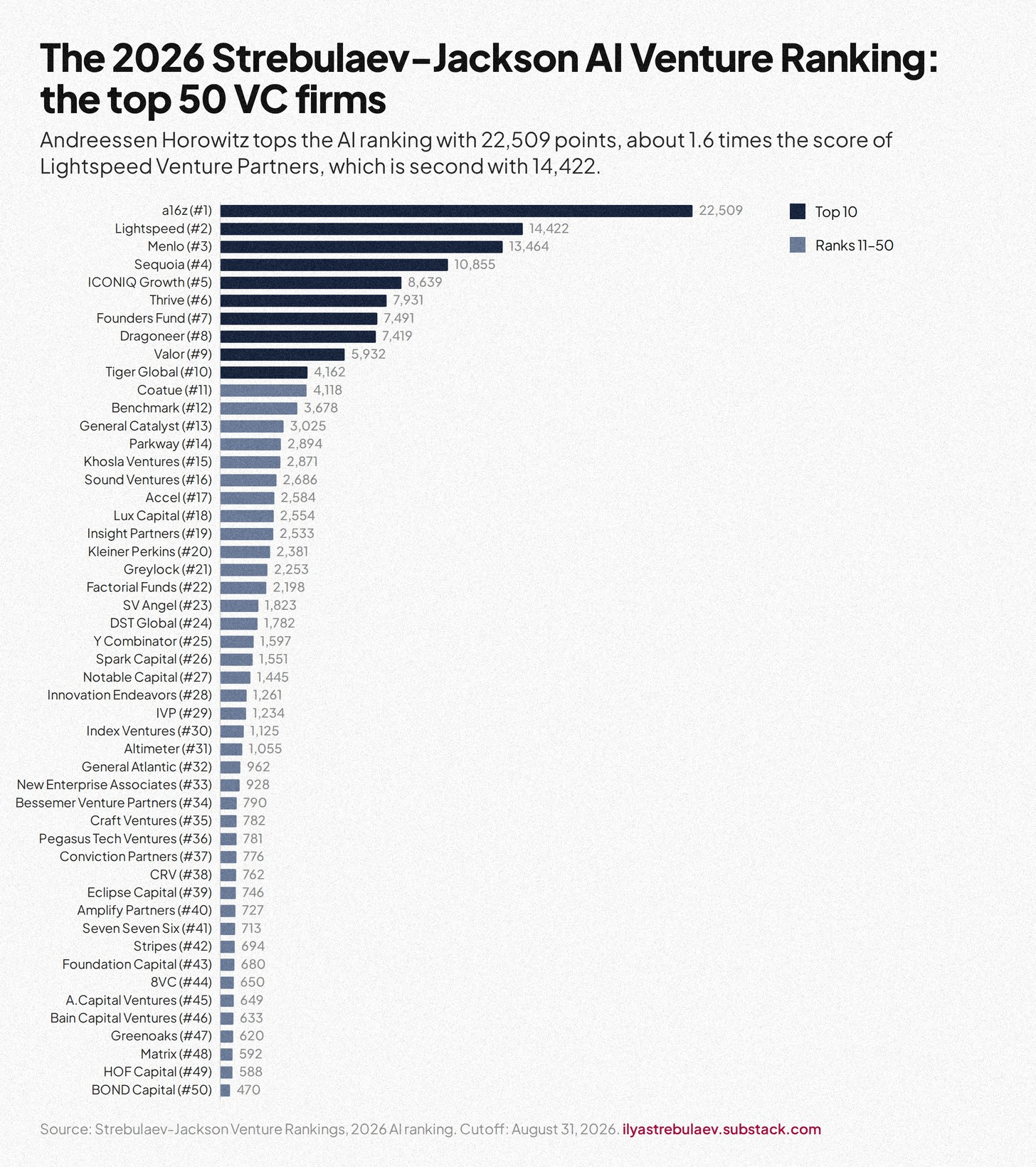
Figure 1
A handful of firms hold most of the AI points
The curve is steeper than in any ranking we have released. By rank 10 the score falls to 4,162, less than a fifth of the leader’s. By rank 50 it is 470, and by rank 100 it is 17. The top firm scores about 48 times the fiftieth firm and nearly 1,300 times the hundredth. In our overall ranking, the top firm scored about 41 times the hundredth. In biotech, it scored about 18 times the fiftieth.
A handful of firms hold most of the AI points. The top three firms hold 29% of all points earned by the top 100. The top ten hold 60%, the top 20 hold 77% and the top 50 hold 95%. Firms ranked 51 to 100 share the remaining 5% (Figure 2).
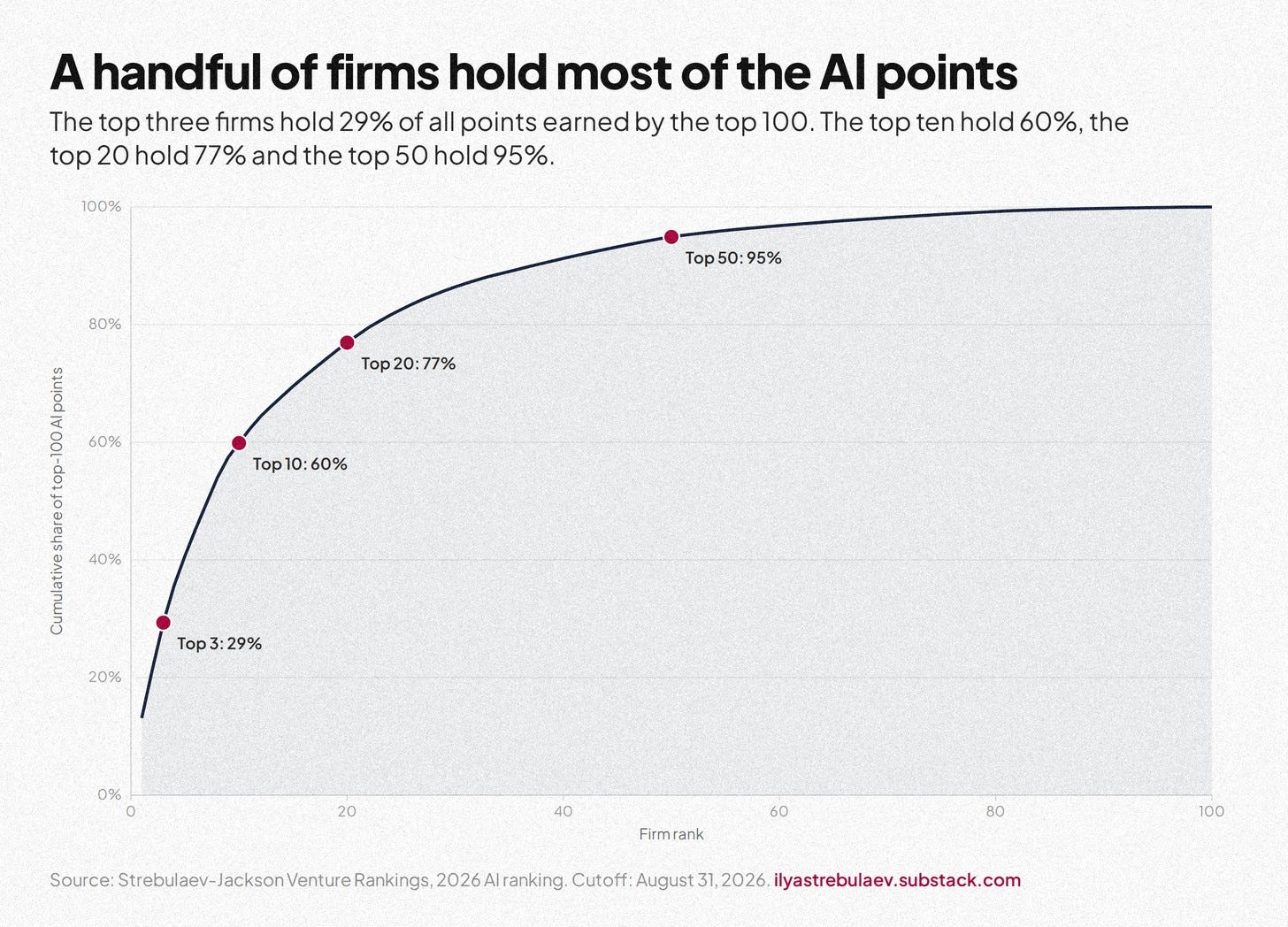
Figure 2
The top ten are good at AI in different ways
All of the top ten VC firms have large AI scores, but they got there in different ways. Here is a short profile of each.
1. Andreessen Horowitz (22,509 points). AI accounts for 64% of a16z’s total score. Its AI points are spread more evenly over time than those of any other firm in the top five, with 56% from investments made since 2023 and 31% from 2015–2019 (across the top 100, the split is 80% and 14%). Our individual Top-100 AI ranking (coming soon) includes 11 of a16z’s investors, more than any other firm.
2. Lightspeed Venture Partners (14,422). Nearly all of Lightspeed’s AI points (99%) come from investments made since 2023, against 80% for the top 100 as a whole, and AI accounts for 73% of its total score. It employs 7 of the top 100 individual AI investors.
3. Menlo Ventures (13,464). Menlo depends on AI more than any other firm in the top five. AI accounts for 93% of its total score, and 99% of its AI points come from investments made since 2023.
4. Sequoia (10,855). Sequoia has the lowest AI share in the top ten, at 39%, yet it employs 6 of the top 100 individual AI investors, third after a16z and Lightspeed. Its AI points come from both the current wave (75% since 2023) and the earlier one (22% from 2015–2019).
5. ICONIQ Growth (8,639). AI accounts for 74% of its total score, and 99% of its AI points come from investments made since 2023.
6. Thrive Capital (7,931). Thrive, in New York, is the highest-ranked firm outside the Bay Area. Over 99% of its AI points come from investments made since 2023, and AI accounts for 69% of its total score.
7. Founders Fund (7,491). AI accounts for 55% of Founders Fund’s total score, the second lowest in the top ten. It earns 88% of its AI points from investments made since 2023, with a further 7% from 2020–2022.
8. Dragoneer (7,419). Dragoneer earns more AI points per investment professional than any other firm in the top 100, about 1,060 for each of its seven. AI accounts for 93% of its total score, the same share as Menlo, and 99% of its AI points come from investments made since 2023.
9. Valor Equity (5,932). Valor, based in Chicago, is the only top-ten firm headquartered outside California and New York. AI accounts for 71% of its total score, and 96% of its AI points come from investments made since 2023.
10. Tiger Global (4,162). Tiger Global draws more of its AI points from older investments than almost any other firm in the top ten, with 28% from 2015–2019. AI accounts for 64% of its total score.
One company anchors a fifth of the ranking
For each firm, we identify its single highest-scoring AI investment. Across the top 100 firms, there are only 47 distinct such companies. Anthropic is the highest-scoring AI investment for 21 firms. xAI is the highest-scoring investment for 8 firms and Databricks for 6. Baseten and Cursor follow with 5 each, and OpenAI and Cerebras Systems with 4 each (Figure 3).
The list spans the whole AI stack. It includes frontier model developers (Anthropic, xAI, OpenAI), infrastructure (Databricks, Baseten, Cerebras Systems, Together AI, Modal Labs) and applications (Cursor, Sierra, Cognition). But a small set of companies anchors much of the ranking.
The power law that shapes firm scores starts at the company level. A few AI companies created most of the value, and the firms with meaningful positions in them rose to the top.
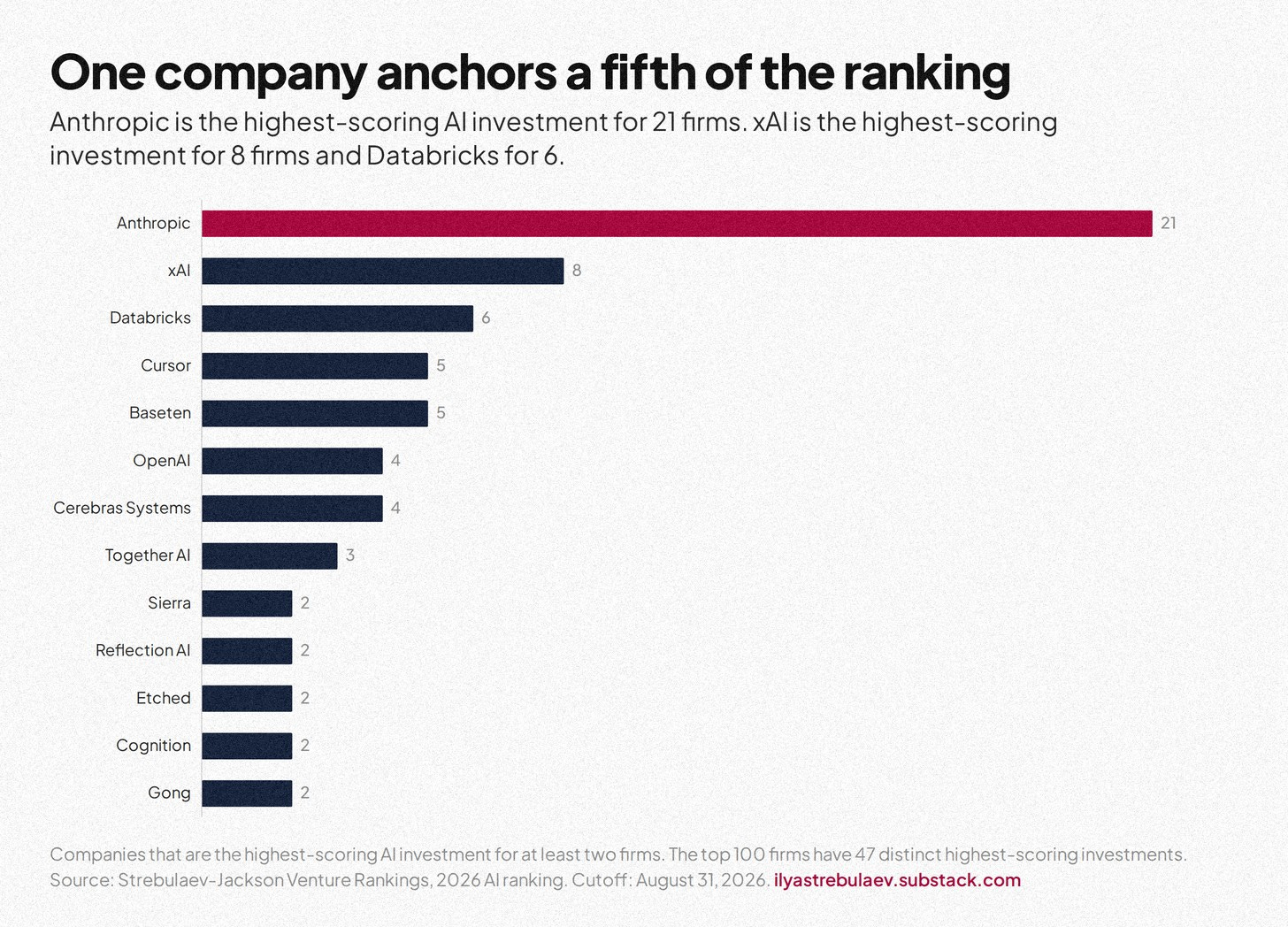
Figure 3
Most AI value comes from investments made since 2023
Most AI points come from investments made since 2023. Across the top 100 firms, 80% of all points come from investments made in 2023 or later (Figure 4). For the median firm, the share is 81%. Thirty-nine firms earn at least 90% of their AI points from these recent investments.
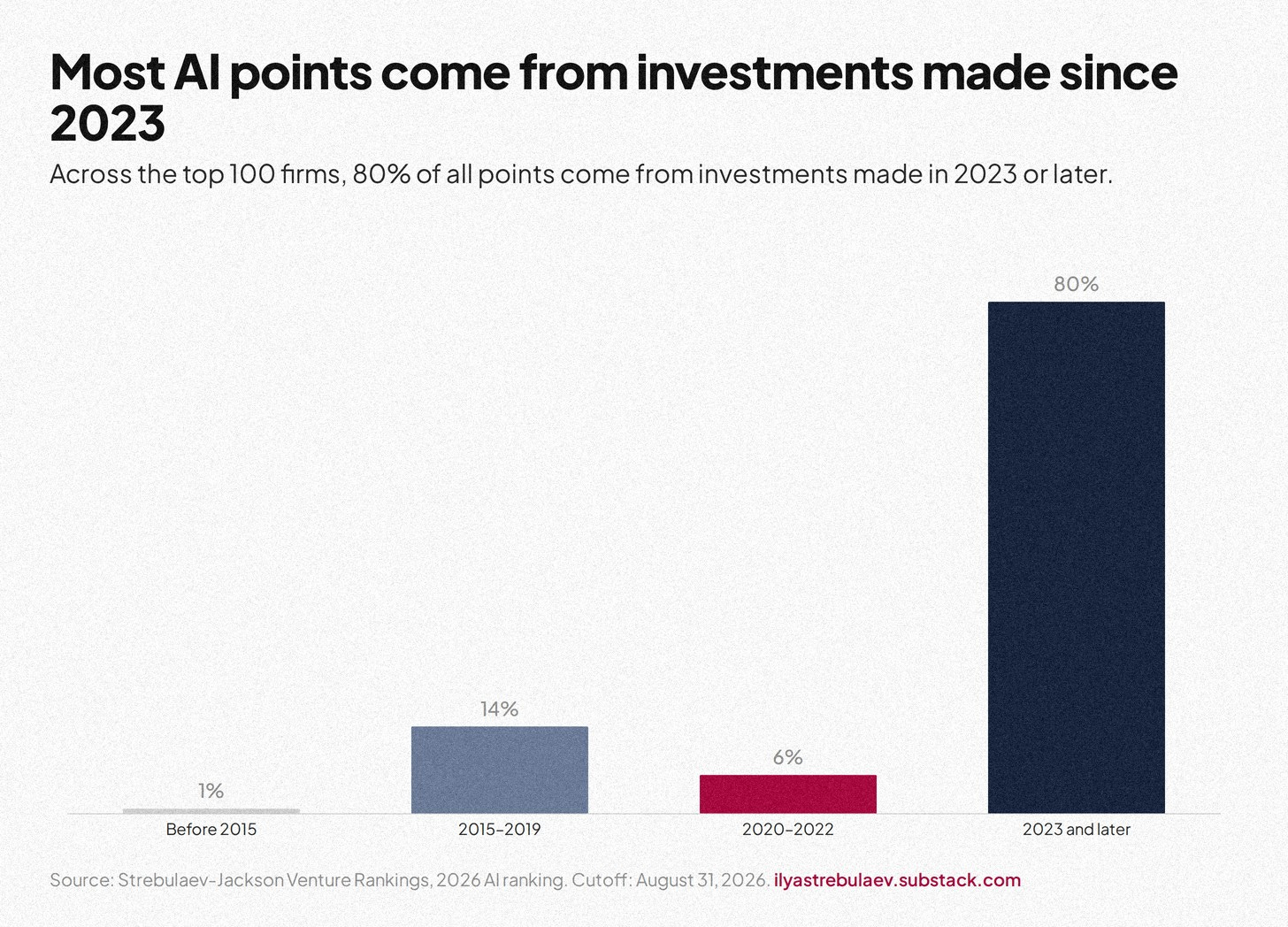
Figure 4
The 2020–2022 boom vintage barely registers
Investments made in 2020–2022 contribute only 6% of all points. Investments made in 2015–2019 contribute 14%, even though they are older and so more heavily discounted. Decay alone would produce the opposite pattern.
The 2020–2022 period was the peak of the last venture boom. Yet the AI investments made in those years account for little of the value in this ranking. Most of the AI companies that drive today’s scores either raised their decisive rounds after 2022 or were founded after it.
A few firms are exceptions. Innovation Endeavors earns 90% of its AI points from 2020–2022 investments. Amplify Partners earns 75% and A.Capital Ventures 58%.
Figure 5 shows the vintage mix for each of the top 20 firms. The thinness for 2020–2022 appears across almost all of them.
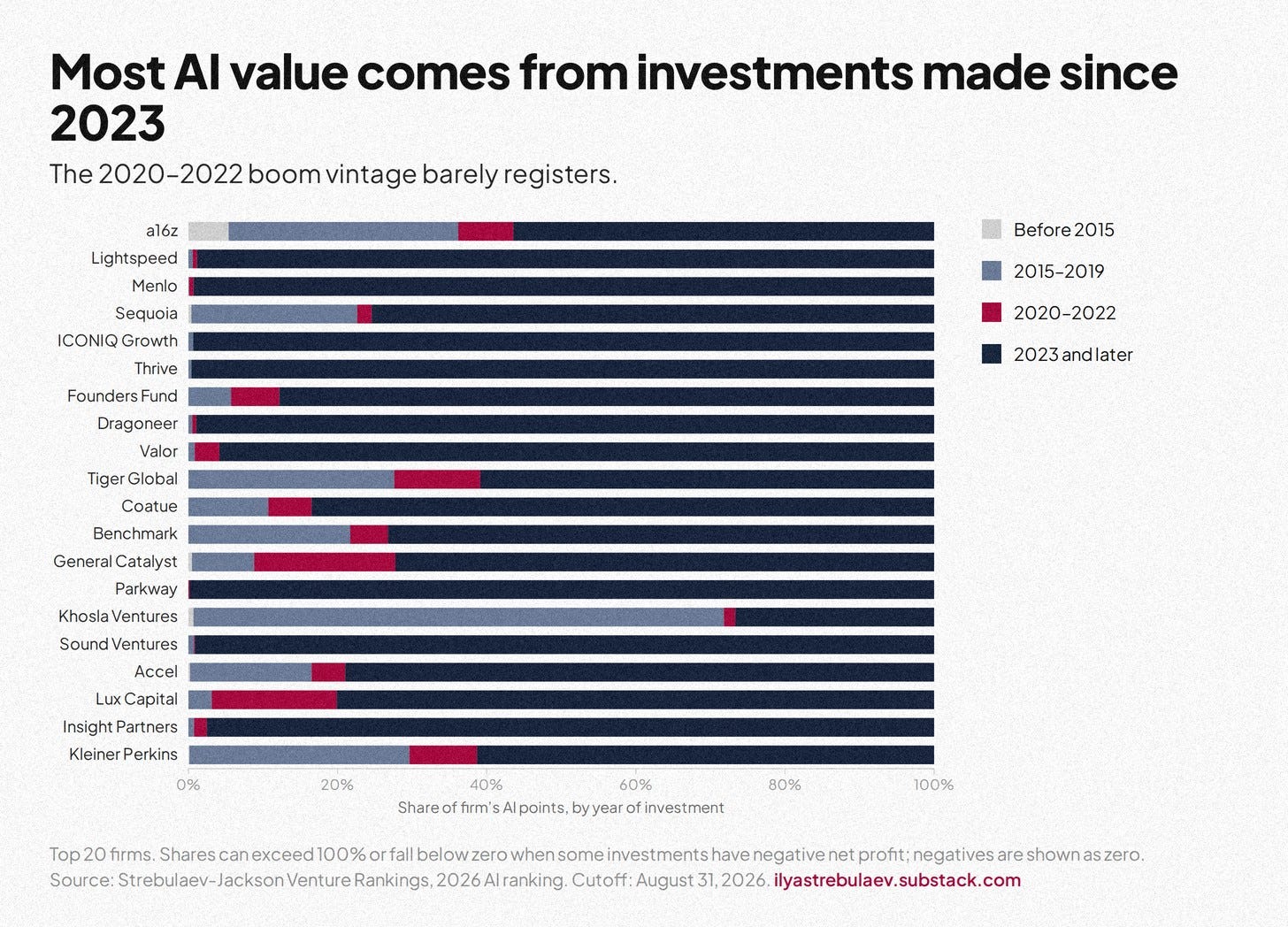
Figure 5
A few firms built their AI positions early
Some firms buck the pattern. Khosla Ventures earns 71% of its AI points from investments made in 2015–2019 and only 27% from 2023 onward. Greylock earns 66% from 2015–2019, Eclipse Capital 75%, Battery Ventures 84% and Y Combinator 83%.
These firms backed AI companies years before the current wave. Innovation Endeavors, which built its AI positions in 2020–2022, earns just 8% of its AI points from investments made since 2023.
At the other end, ICONIQ Growth, Thrive Capital and Dragoneer earn about 99% of their AI points from investments made since 2023. For Factorial Funds, the share is 100% (Figure 6).
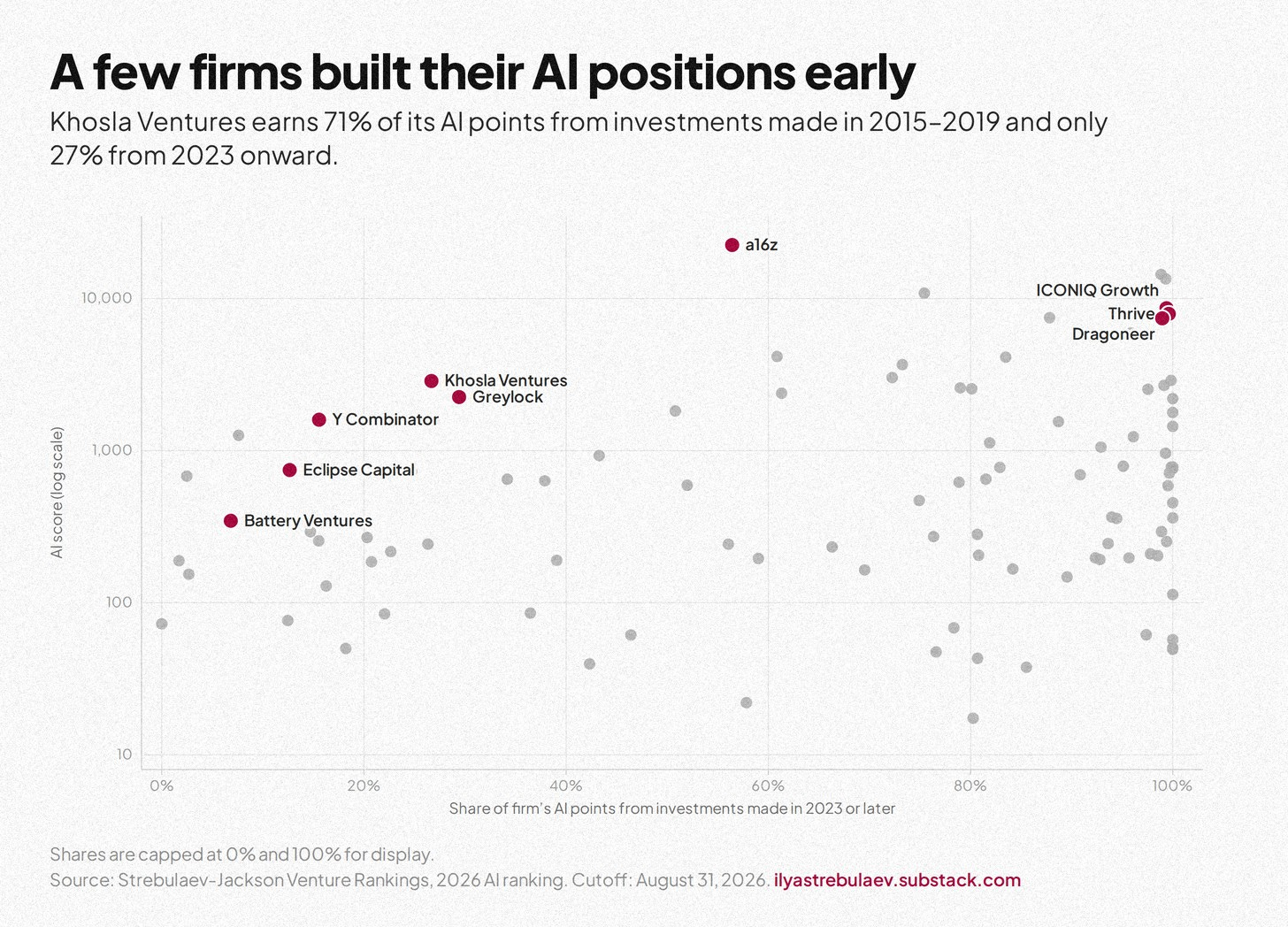
Figure 6
Some top firms are all-in on AI; others are not
For each VC firm, we also compute the share of its total score, across all sectors and at the same cutoff, that comes from AI. This shows how much a firm’s success depends on AI. Figure 7 shows the share for each of the top 20 firms.
AI specialists
Twelve firms earn more than 90% of their total score from AI. Two of them are in the top ten: Menlo Ventures (93%) and Dragoneer (93%). The others include Parkway Venture Capital (100%), Factorial Funds (98%), Pegasus Tech Ventures (98%) and Maven Ventures (98%) and Sound Ventures (95%).
One firm, Scale-Up, exceeds 100%. Our data shows that its non-AI investments have negative net profit, so its AI investments created more value than its portfolio as a whole.
Low AI loading among top firms
Sequoia has the lowest AI loading in the top ten. AI accounts for 39% of its total score. It ranks fourth in AI and still earns most of its score elsewhere. Founders Fund is next, at 55%.
Further down, AI is a small share of the total for several large firms: 5% for Norwest, 11% for Mayfield Fund, 12% for Paradigm and First Round, and 13% for Addition. For these firms, AI is so far a small part of the value they have created.
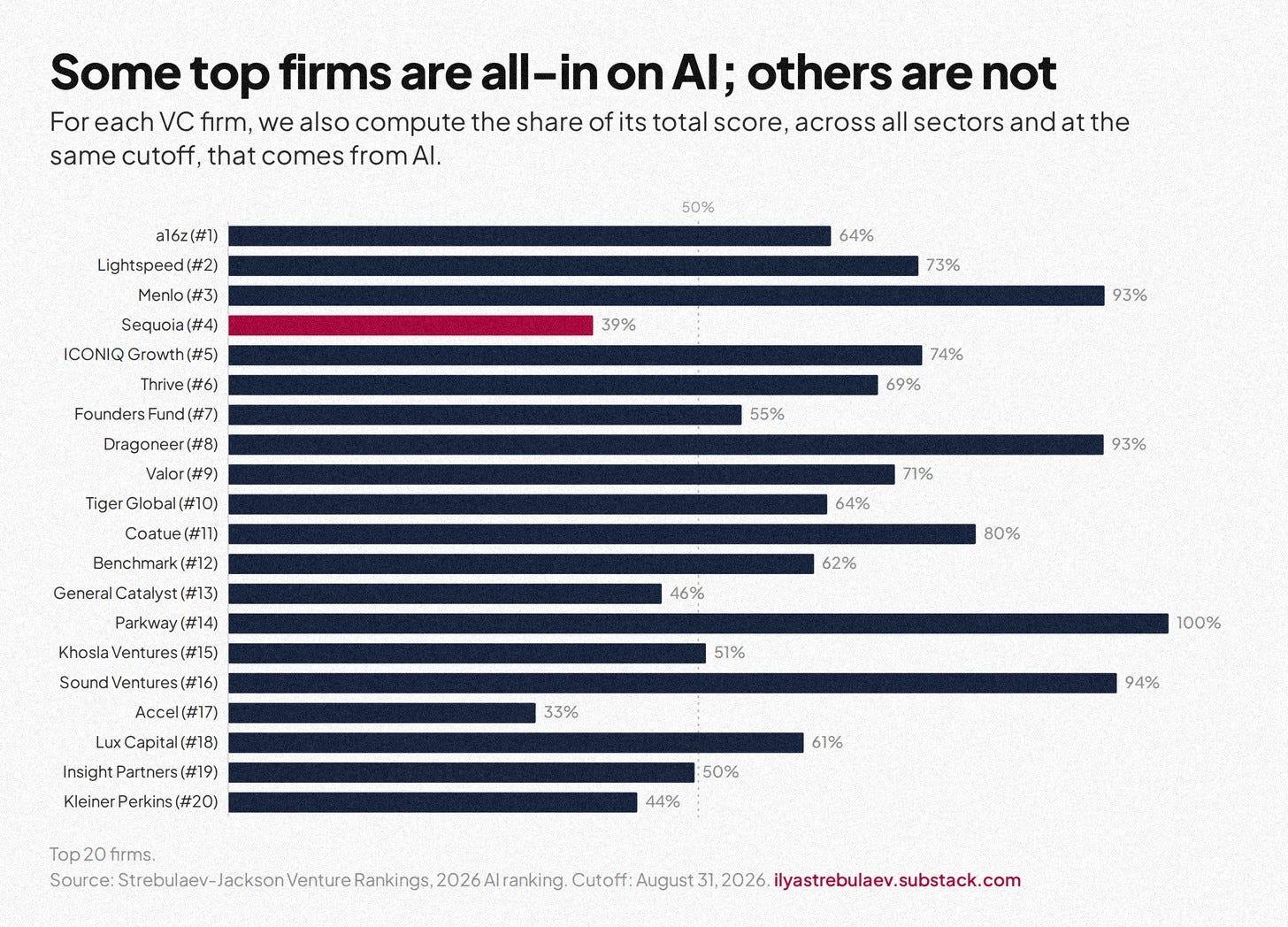
Figure 7
AI is already a large share of most firms’ scores
Across the top 100, the median firm earns 48% of its total score from AI. For 48 firms, AI accounts for more than half of the total. Only 13 firms earn less than 20% of their score from AI. Given that most of this value was created in the past three years, AI already accounts for a large share of what these firms have achieved.
AI specialists and generalists both reach the top. Figure 8 plots each firm’s AI score against its AI share. Menlo and Dragoneer sit at the top right, with large AI scores and almost all of their value in AI. Andreessen Horowitz sits at the top in the middle, with 64% of its score from AI. Sequoia ranks high with AI below half of its total.
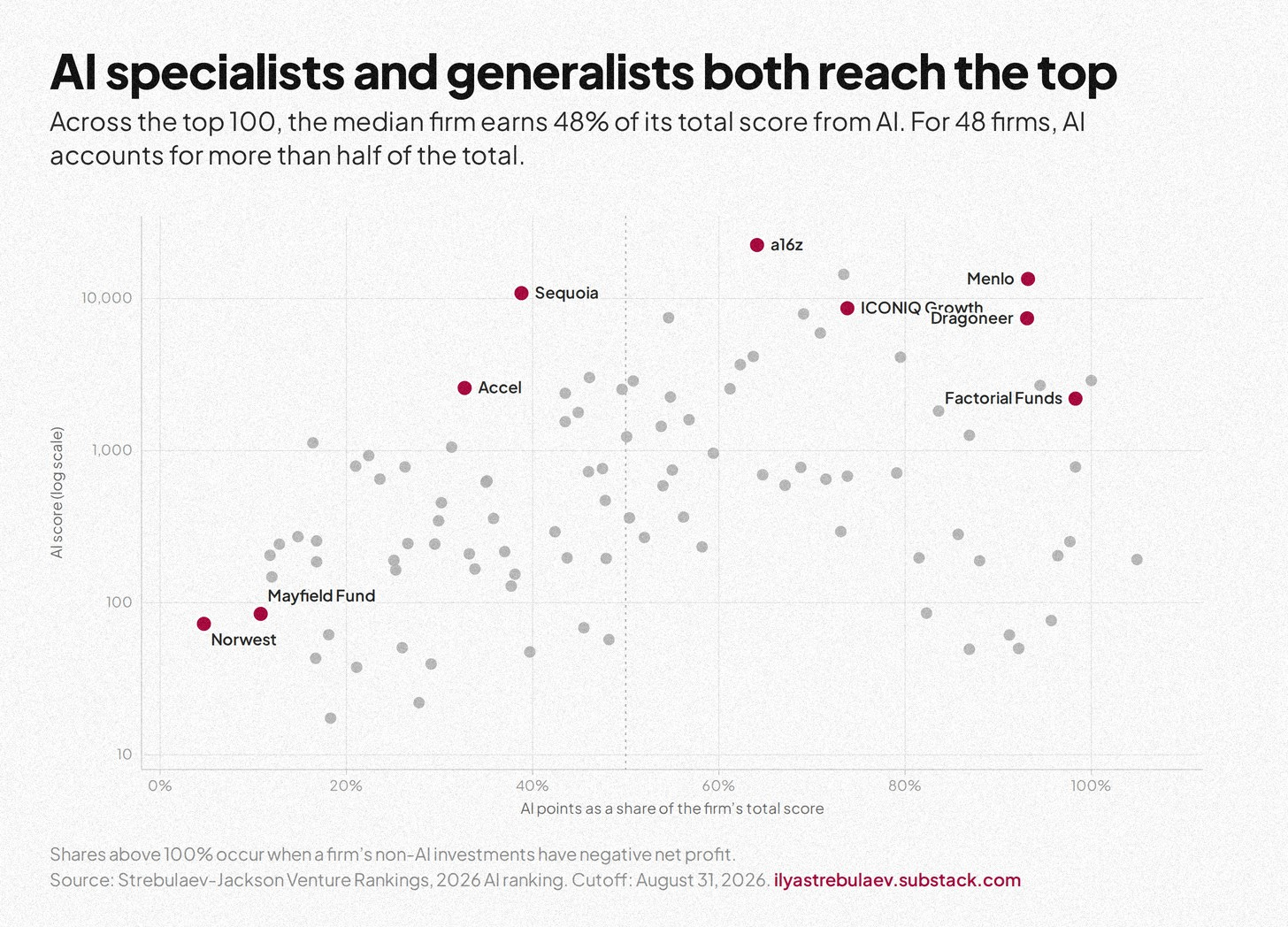
Figure 8
Unicorn counts do not predict AI rank
This ranking is not a tally of unicorns. Accel has 173 unicorns globally overall, the same number as Andreessen Horowitz, yet ranks 17th in AI to a16z’s first. Sequoia has the most unicorns in the top 100, 211, and ranks fourth. Tiger Global (158 unicorns) ranks 10th, Kleiner Perkins (146) 20th, SV Angel (144) 23rd and Y Combinator (143) 25th.
Meanwhile, Menlo ranks third with 50 unicorns and Dragoneer eighth with 22. Factorial Funds ranks 22nd with 5 unicorns, and Parkway Venture Capital ranks 14th with just 2.
A unicorn count measures breadth across all sectors. Our score measures value created in AI, net of cost, dilution and decay. A firm with a few large positions in the right AI companies can outrank a firm with ten times as many unicorns (Figure 9).
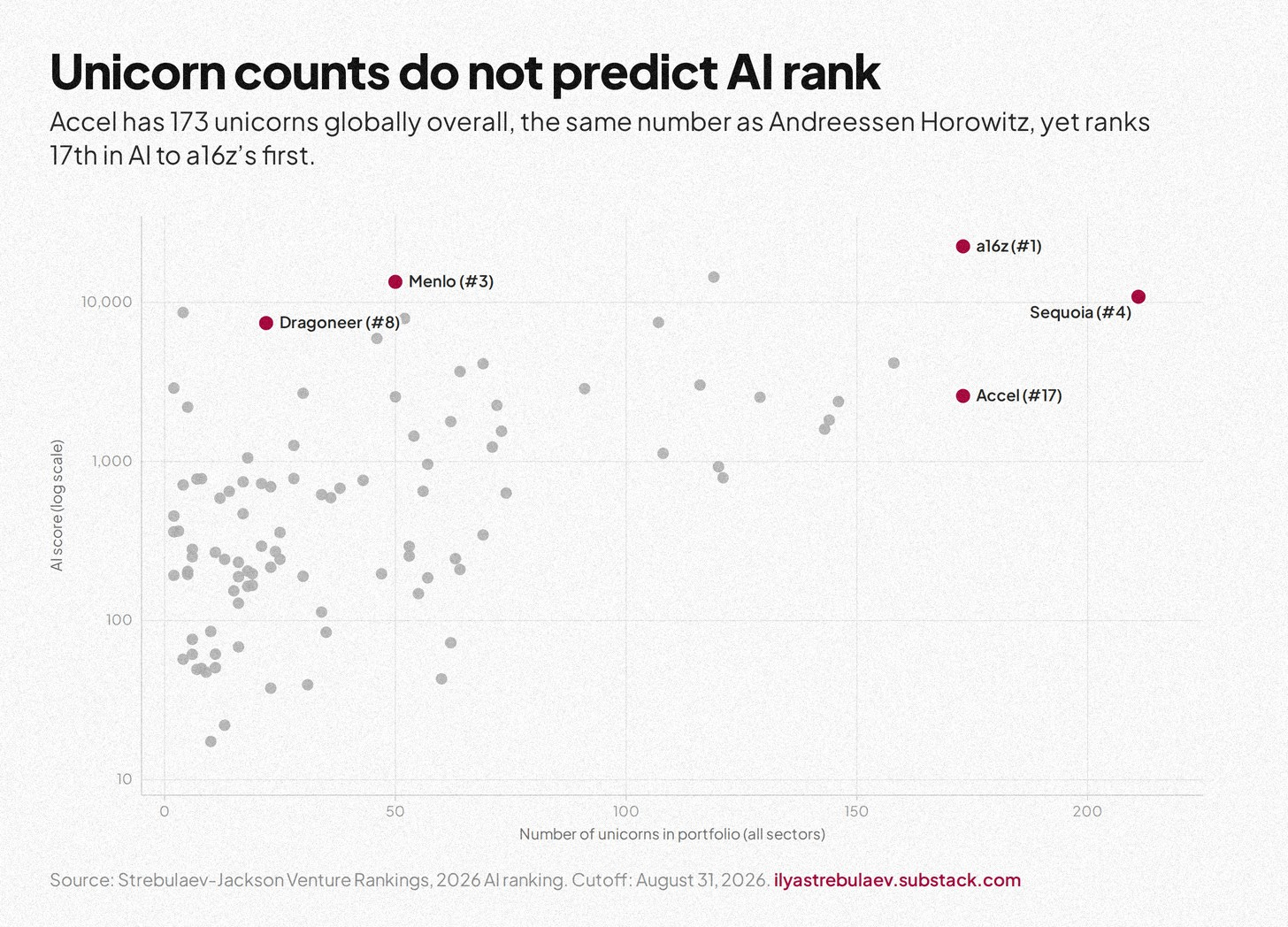
Figure 9
Some crossover funds made it to the top of the ranking
Several of the top 20 firms are crossover, growth or hedge-fund-style investors rather than traditional venture firms: ICONIQ Growth (5th), Dragoneer (8th), Valor Equity (9th), Tiger Global (10th), Coatue (11th) and Insight Partners (19th).
These firms tend to take large minority stakes in late-stage rounds and few or no board seats. Their AI points are almost entirely recent. ICONIQ Growth, Dragoneer and Valor Equity each earn between 96% and 100% of their AI points from investments made since 2023.
Small funds post outsized AI scores
Size helps, but less than one might expect. Across the 86 firms out of our 100 for which we have reliable measures of assets under management, larger firms tend to have higher AI scores, but the relationship is not perfect. On average, doubling assets under management goes with a roughly 40% higher AI score (Figure 10).
Small funds post outsized AI scores. Parkway Venture Capital manages about $115 million and ranks 14th. Factorial Funds (~$950 million) ranks 22nd. Sound Ventures (~$1 billion) ranks 16th. Parkway earns about 25,200 points per billion dollars under management, compared with about 210 for Andreessen Horowitz. Menlo Ventures, with $6.8 billion, ranks third, ahead of Sequoia, which manages about twelve times more.
For very large managers, such as General Atlantic, AI venture investments are a small part of a much larger book.
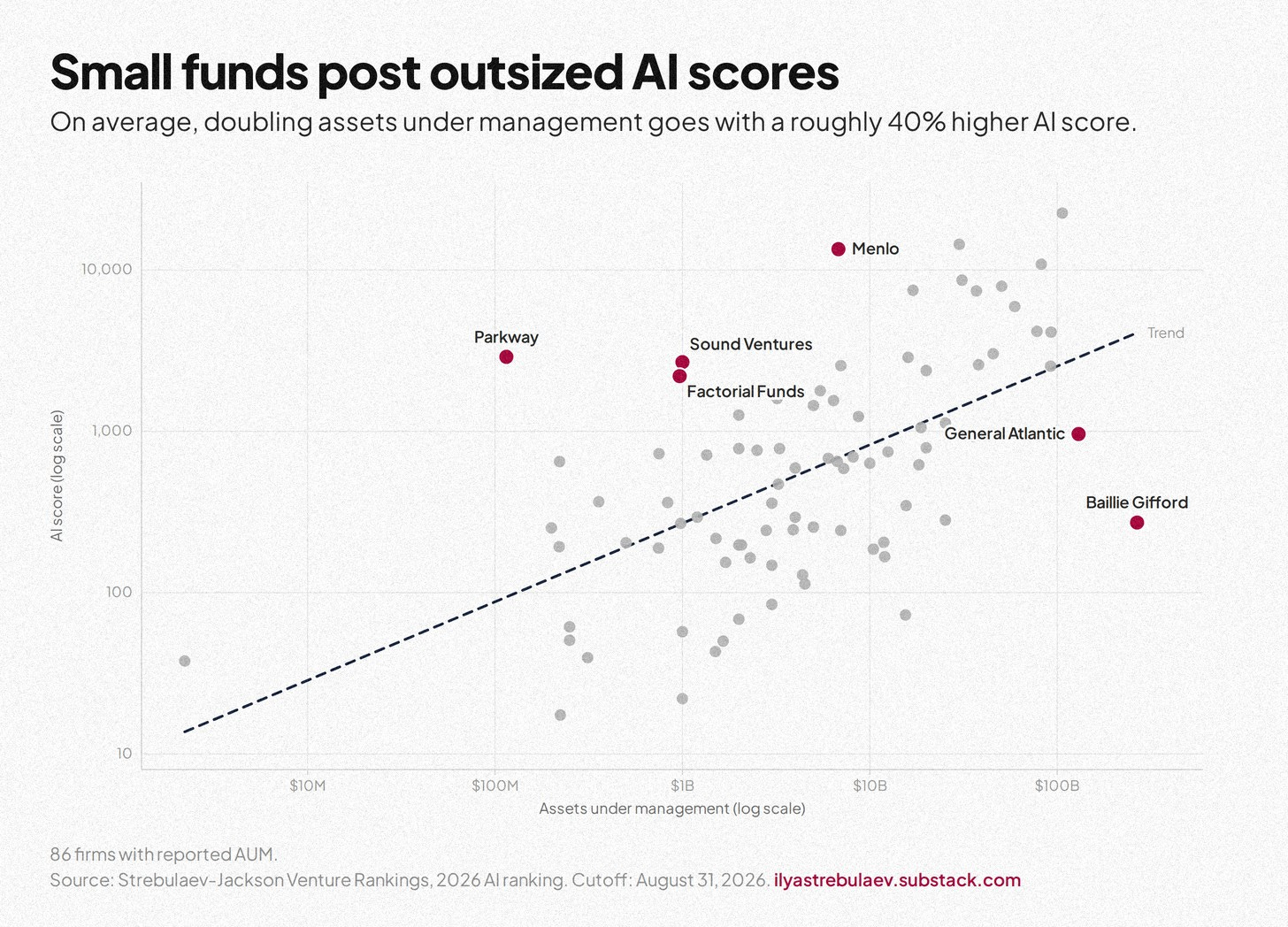
Figure 10
Small teams generate outsized AI scores
The same pattern holds for team size. (Our data on team size comes from firm websites, commercial datasets, and LinkedIn.) Dragoneer’s seven investment professionals generate 7,411 points, about 1,060 per person. Thrive Capital (12 professionals) earns about 660 points per person, Founders Fund (12) about 620, Menlo Ventures (22) about 610 and DST Global (3) about 590.
Menlo’s 22 investment professionals produce nearly the same score as Lightspeed’s 57: 13,464 points against 14,422. Andreessen Horowitz, the leader, earns about 250 points per professional across a 90-person investment team. Insight Partners, with 232 investment professionals, earns about 11 (Figure 11).
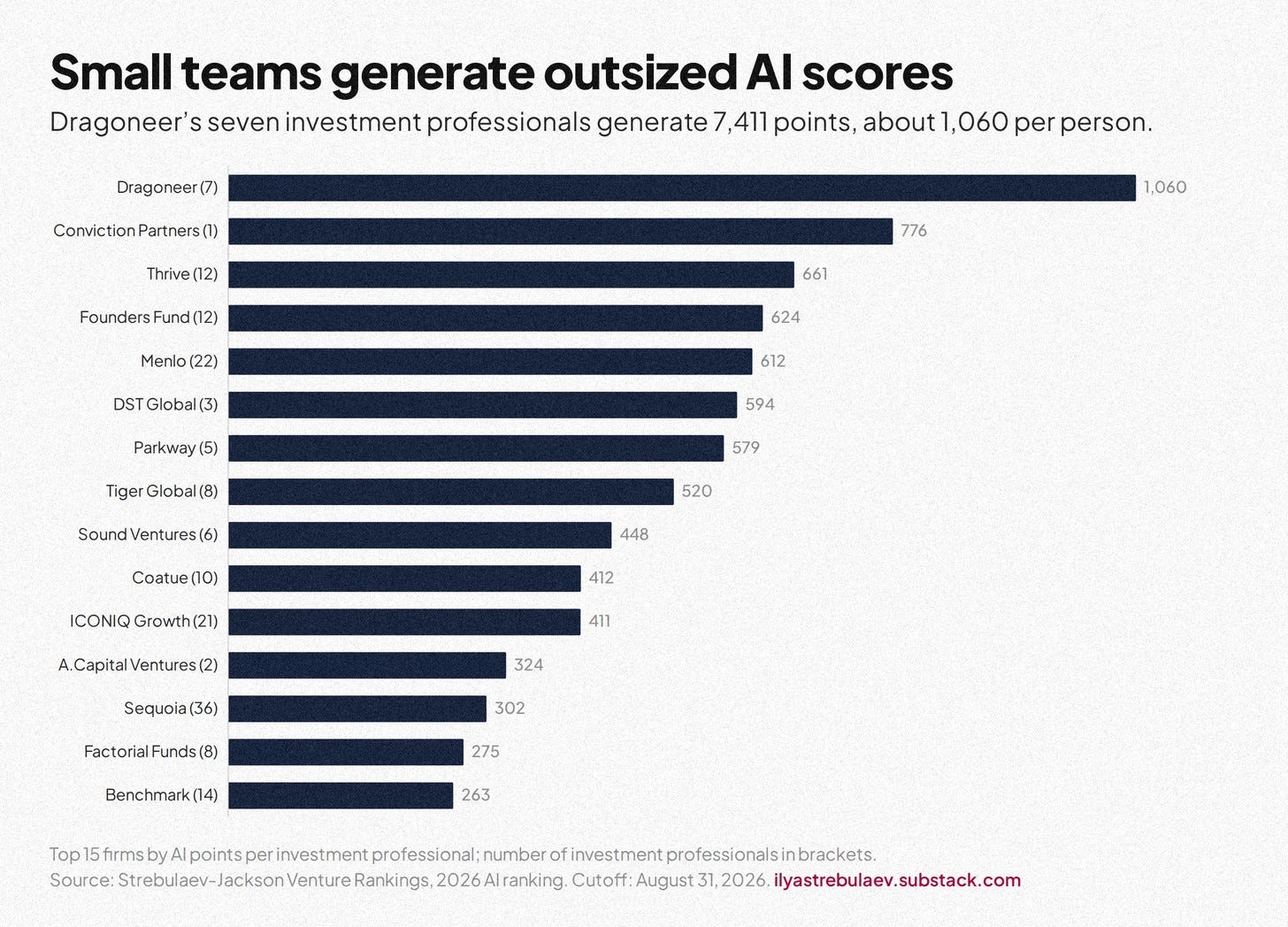
Figure 11
Beyond the top 20, familiar names rank lower and specialists rise
Ranks 21 to 50 show the same forces at work. Three observations stand out.
Established multistage firms with low AI loading
For several well-known firms AI is a modest part of what they have created so far. Index Ventures ranks 30th, with AI at 16% of its total score. New Enterprise Associates ranks 33rd (22%), Bessemer Venture Partners 34th (21%), Altimeter 31st (31%), 8VC 44th (24%), Greenoaks 47th (35%) and Craft Ventures 35th (26%).
Their AI ranks do not mean these firms lack AI investments. They mean that, by our measure, their AI positions have so far created less value than their positions elsewhere.
Smaller firms concentrated on AI
A second group relies heavily on AI. Pegasus Tech Ventures (36th) earns 98% of its total score from AI. Innovation Endeavors (28th) earns 87%, Seven Seven Six (41st) 79%, A.Capital Ventures (45th) 72% and Conviction Partners (37th) 69%. Notable Capital (27th) and HOF Capital (49th) each earn 54% of their total score from AI. Almost all of it comes from investments made since 2023.
Many of these firms are small. Seven Seven Six has four investment professionals and A.Capital Ventures two.
Firms that built AI positions before the current wave
A third group earns its AI points mostly from older vintages. Y Combinator (25th) earns 83% of its AI points from 2015–2019 investments, and Eclipse Capital (39th) 75%. New Enterprise Associates earns 45% and Foundation Capital (43rd) 73%. Amplify Partners (40th) earns 75% from 2020–2022, and A.Capital Ventures 58%. These firms show that early AI positions can still rank today, even after heavy decay.
The Bay Area dominates
Sixty-seven of the top 100 AI firms are headquartered in California, 64 of them in the Bay Area: 29 in San Francisco, 14 in Menlo Park and 12 in Palo Alto. Seven of the top ten are in the Bay Area.
New York is second with 18 firms, including two of the top ten: Thrive Capital and Tiger Global. Texas, Massachusetts and the Los Angeles area have three firms each. Valor Equity, in Chicago, ranks ninth.
Measured by points rather than firm counts, the concentration is even stronger. Bay Area firms hold 74% of all points earned by the top 100. New York firms hold 17%. Twelve of the top 20 firms are in the Bay Area.
Five firms are headquartered outside the US: Index Ventures (London), DST Global (Global), Baillie Gifford (Edinburgh), Radical Ventures (Toronto) and K2 Global (Singapore). The ranking counts only investments in US AI companies, but the capital comes from around the world (Figure 12).
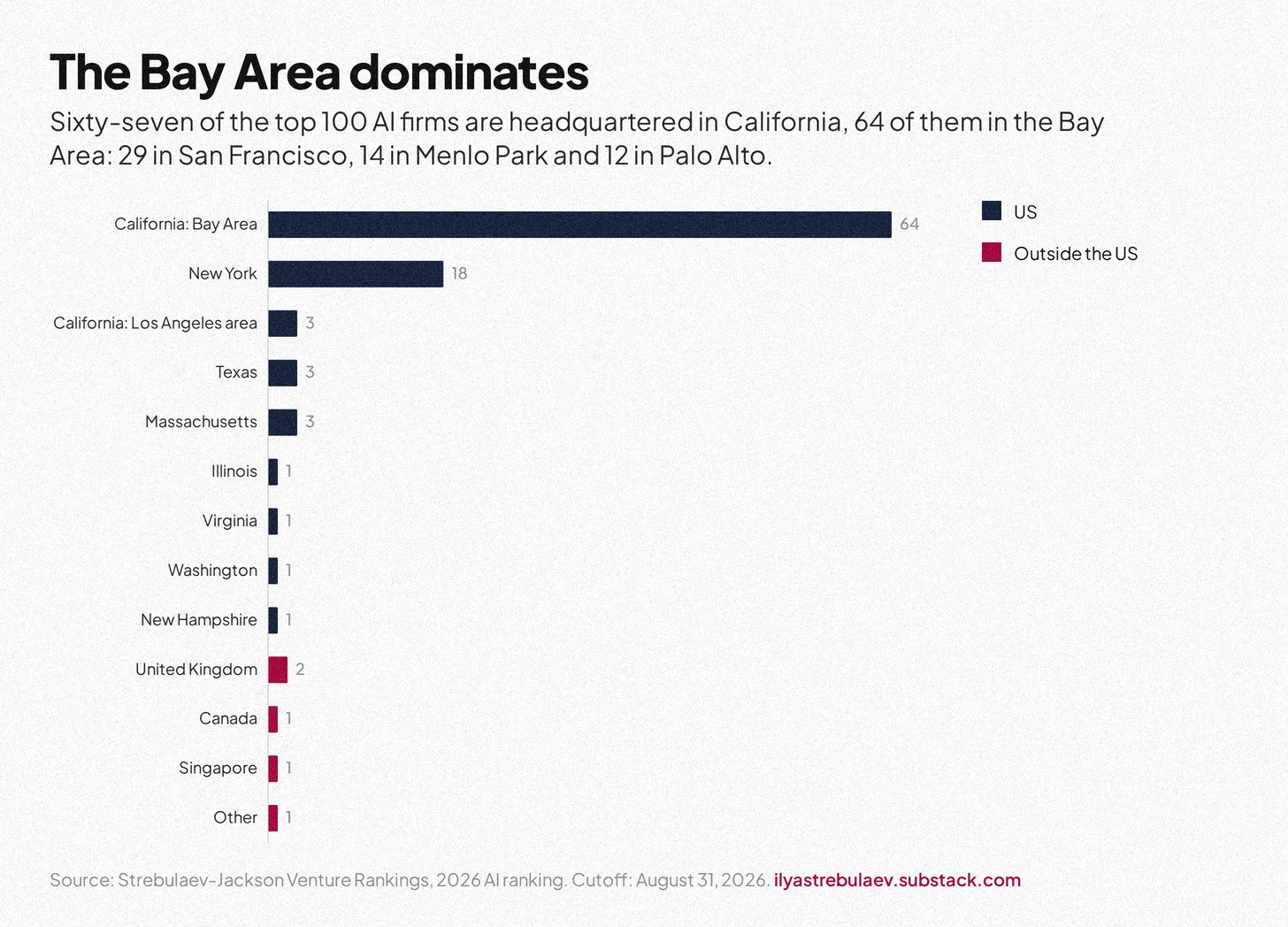
Figure 12
The best AI investors cluster in a few firms
Our companion release ranks individual AI investors. Here is a preview. Talent is even more concentrated than firm scores.
Andreessen Horowitz employs 11 of the top 100 individual AI investors. Lightspeed Venture Partners employs 7, Sequoia 6 and Kleiner Perkins 3. These four firms employ 27 of the top 100. At the other end, 51 of the top 100 firms employ none (Figure 13).
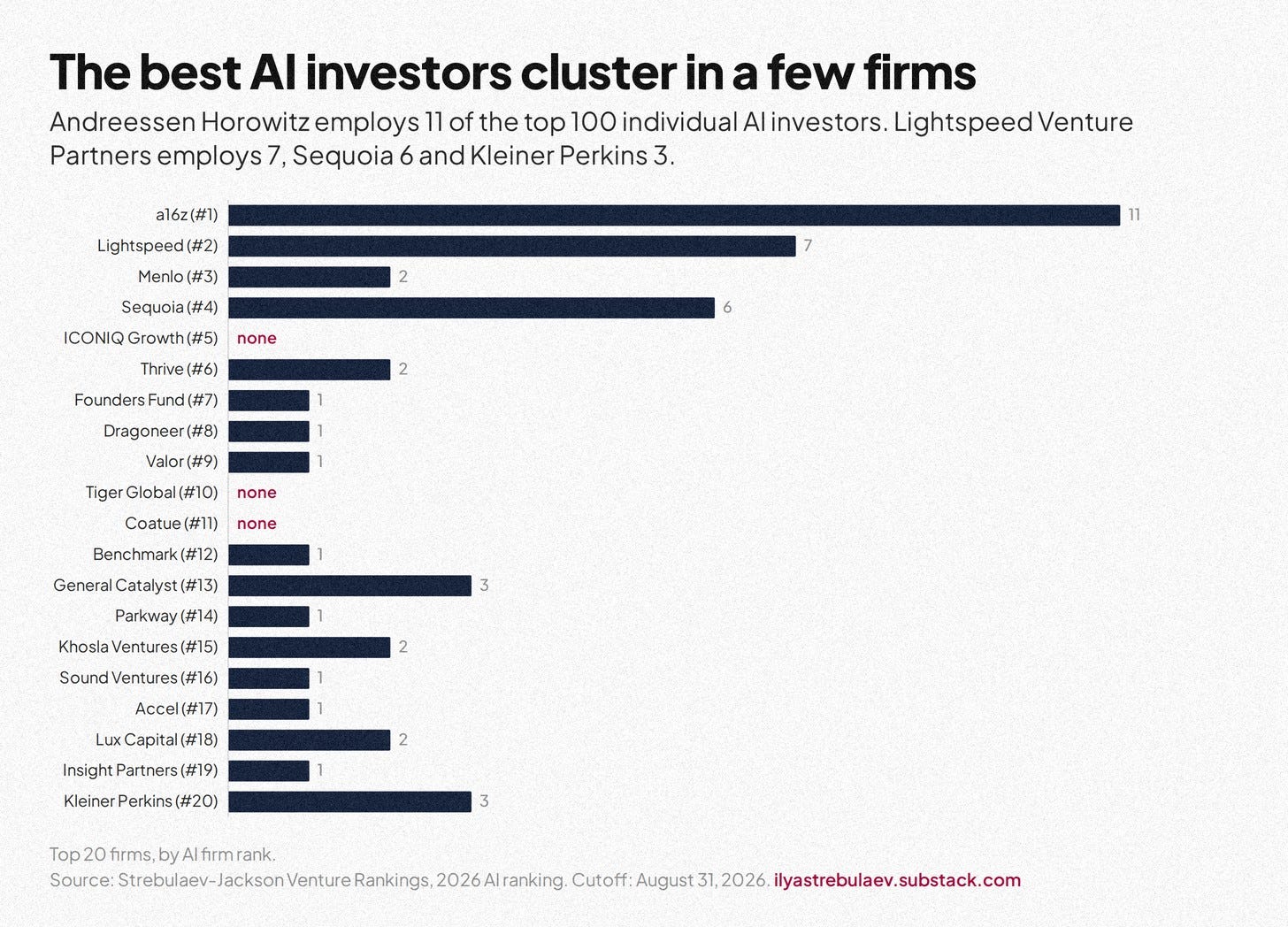
Figure 13
What this means for founders and LPs
For founders
Look past the brand. Some of the best-known firms in venture rank far lower in AI than their overall reputation suggests. If you are building an AI company, ask what share of a firm’s success comes from AI and how recent that success is. A firm whose AI points come from investments made a decade ago may know the field well, but its recent track record is a different question.
Look at the person, not only the firm. Star AI investors cluster in a few firms, and several top-ranked firms employ none of them. The partner who joins your board matters more than the logo. Our individual ranking, coming next, will help with that question.
Know what kind of investor you are taking. Crossover and growth investors rank high in AI, but they tend to take minority stakes in late rounds and few or no board seats. That can be exactly what a late-stage company needs. It is not the same as an early-stage partner who works with you every week.
Do not dismiss small firms. Several of the highest-scoring firms per dollar and per investment professional manage less than $1 billion and have a handful of investment professionals.
For limited partners
Check how concentrated a manager’s AI record is. Across the top 100, a few companies account for much of the value. A manager’s AI score may rest on one or two positions. That is how venture works, but it is worth knowing before committing capital.
Remember that most AI value is unrealized. Most points in this ranking come from investments made since 2023, and most of those companies are still private. We discount private valuations, but the marks can still move a lot in either direction.
Use AI share as a lens. The share of a manager’s total score that comes from AI tells you how much its record depends on one theme. A high share is not good or bad in itself, but it shapes portfolio exposure.
Size is not destiny. Larger firms score higher on average, but the relationship is imperfect, and small funds appear throughout the top 50.
Our ranking caveats
Every ranking has limits. It is important to acknowledge them. Here are the ones I think matter most for this one.
Most of the value is unrealized and recent. The ranking measures value created to date, mostly in private companies whose valuations can change quickly. We discount private valuations uniformly, but a sharp change in AI valuations would reshuffle the ranking.
A few companies drive much of the ranking. Anthropic is the highest-scoring AI investment for 21 of the top 100 firms. A large change in the value of a handful of companies would move many firms at once.
Classification involves judgment. We apply our classification consistently, and every company that can move a firm’s position was reviewed manually. But some cases are grey and experts may disagree on the classification outcomes.
It measures value created, not fund returns. The score is not an IRR or a net-of-fees return to limited partners. It does not tell you how a particular fund performed.
It covers only investments in US AI companies. A firm’s AI investments outside the US do not count. We are working on a global version and should release it soon.
Data is not perfect. VC data is notoriously opaque. I have spent many years working to make it better. Still, gaps remain.
The 2026 AI ranking: the top 100 firms
Below are the top 100 firms: rank, firm and AI score.