
We recently released the 2026 Strebulaev-Jackson AI Venture Ranking of the top 50 VC firms.
Firms raise the funds, but individual investors pick the companies, negotiate the terms and sit on the boards. So today we release the companion ranking, the top 100 AI venture capitalists.
Like the firm ranking, it scores investors only on their investments in US-based AI companies. Every point in this ranking comes from an AI company.
We use the same methodology for all venture rankings. The cutoff date for this ranking is August 31, 2026. The full methodology is in our working paper (Strebulaev and Jackson, 2026). The 2026 Venture Ranking of the top 100 VC firms is here.
The full analysis, including the top 100, ranks 101 to 200 and an interactive Airtable with the data behind every score, is already available to Paid members.
You can upgrade now to get immediate access.
Paid & Founding members will unlock valuable insights for founders and VCs:
● The full top 100 AI venture capitalists, with their firms and scores
● Ranks 101 to 200 in addition, another 100 investors, 21 of them at firms outside the top 100 AI VC firms
Here is a sneak peek at the Airtable.
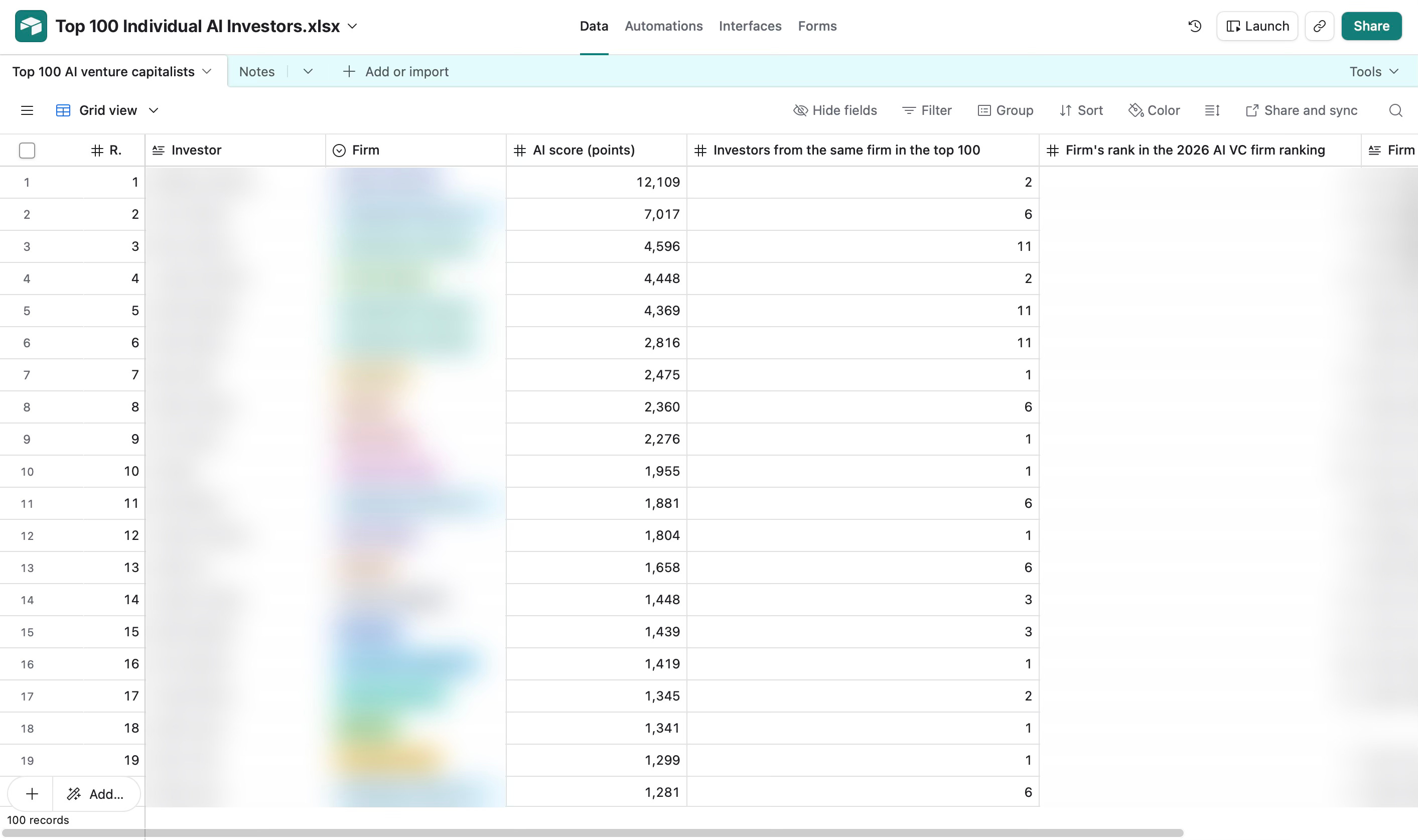
A paid subscription covers more than this ranking. It also gives you every other ranking we publish in full, with up to 200 more investors scored in each; our proprietary data on the top VC and angel investors and on unicorns; the cheat sheets from my Stanford VC and PE classes; and fundraising guides from first outreach to deal terms.
Firms invest, but people make the decisions
A founder takes money from a VC fund but works with a specific person. The partner who leads the round shapes the terms, joins the board, and stays with the company for years. A limited partner backs a fund, but the fund’s results depend on a handful of people inside it. And people move. A star investor can leave, start a new firm or step back.
This is why we rank individuals as well as firms. As I show below, in AI the two rankings tell different stories. At some firms one investor accounts for most of the firm’s AI score. Other firms rank in the top ten without a single investor in the individual top 100.
We use the same AI classification and the same six factors
The individual ranking uses the same AI classification as the firm ranking. We classified 728 US-based VC-backed companies as AI. Our main tool is the removal test: strip the AI out of the company and ask whether the product still exists as something customers buy. The VC firm ranking post describes the rules, the grey zones and the review process in detail.
The score rests on the same six factors as all our rankings:
1. Valuation
2. Dilution
3. Net profit
4. Value add
5. Human-capital decay
6. The split of credit between firms and individuals.
These factors are objective, transparent and replicable. See here for details.
The full top 100 and ranks 101 to 200 are available to paid subscribers, and I summarize the main features of ranks 101 to 200 at the end of this post.
Matthew Murphy leads the AI ranking
Matthew Murphy of Menlo Ventures tops the AI ranking with 12,108 points, about 1.7 times the score of Guru Chahal of Lightspeed Venture Partners, who is second with 7,017. Ben Horowitz of Andreessen Horowitz (4,596), Joshua Kushner of Thrive Capital (4,448) and David George of Andreessen Horowitz (4,369) complete the top five. Sarah Wang (Andreessen Horowitz), Marc Stad (Dragoneer), Patrick Grady (Sequoia), Eric Vishria (Benchmark) and Sol Bier (Factorial Funds) complete the top ten. Figure 1 shows the top 100 AI venture capitalists.
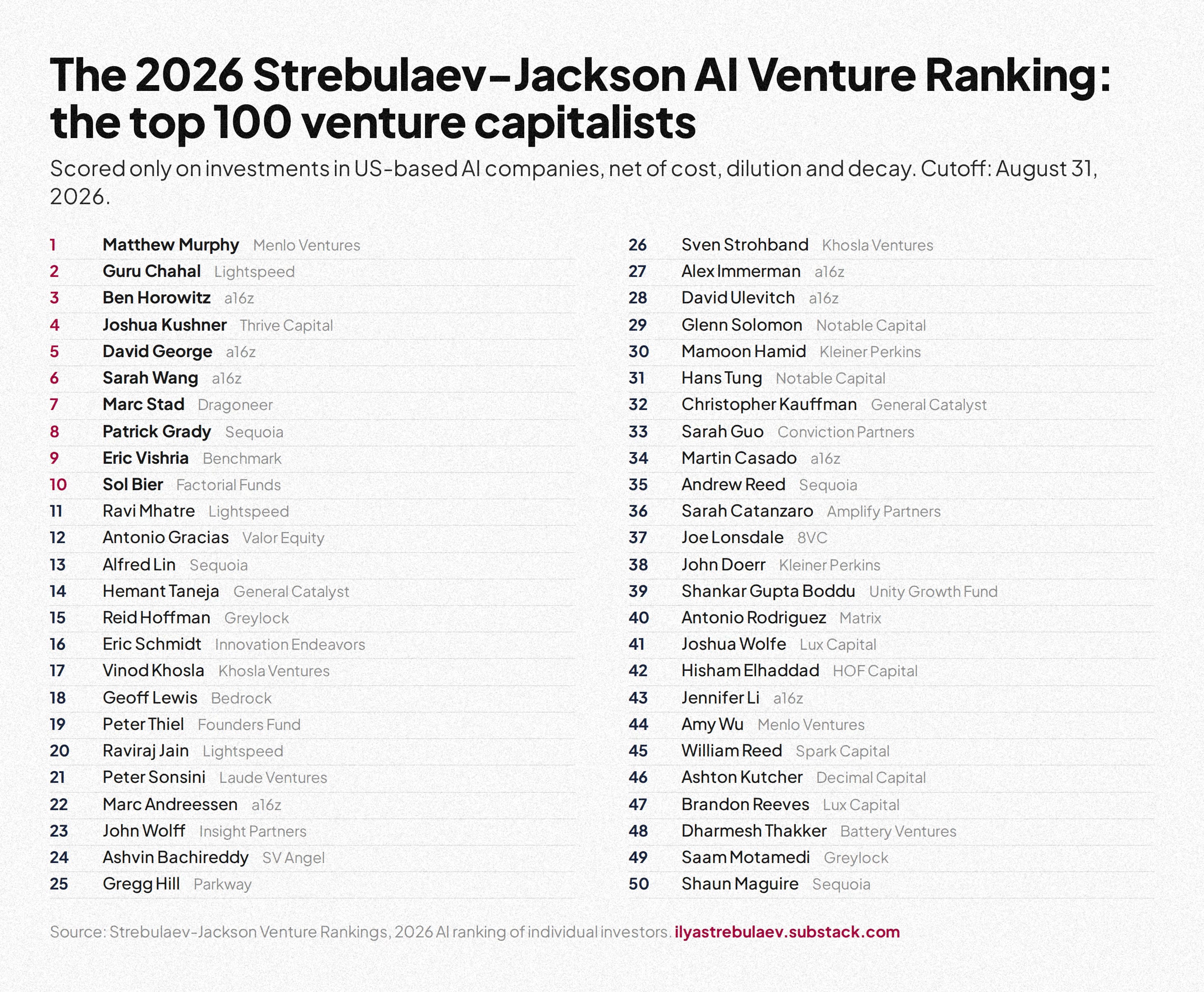
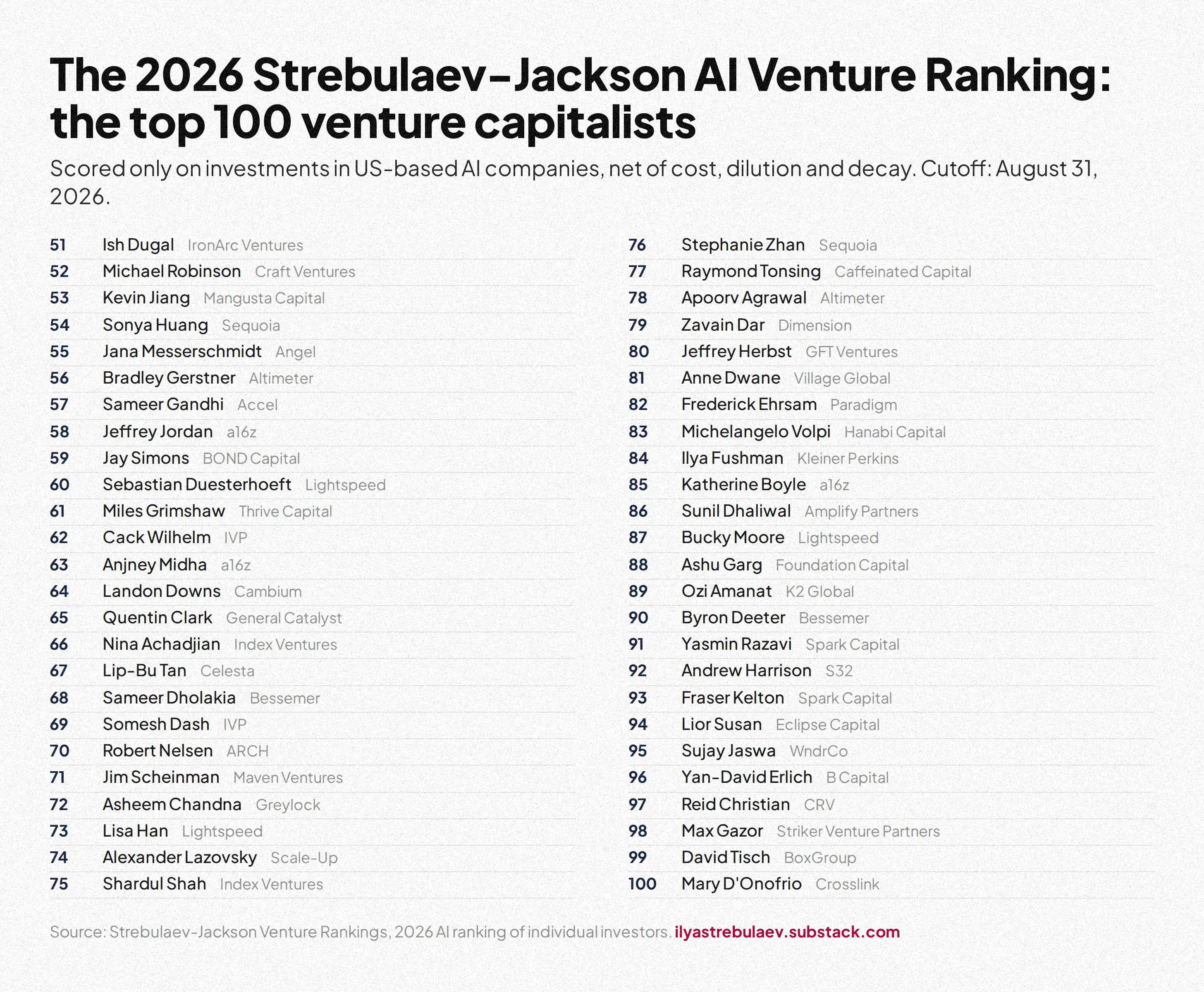
Figure 1
A handful of investors hold most of the AI points
By rank 10 the score falls to 1,955, about a sixth of the leader’s. By rank 50 it is 355, and by rank 100 it is 153. The top investor scores about 34 times the fiftieth and about 79 times the hundredth. The curve is steep, but less steep than for VC firms, where the top firm scored nearly 1,300 times the hundredth.
A handful of investors hold most of the AI points. The top three hold 27%, the top ten 50%, the top 20 67% and the top 50 87% (Figure 2).
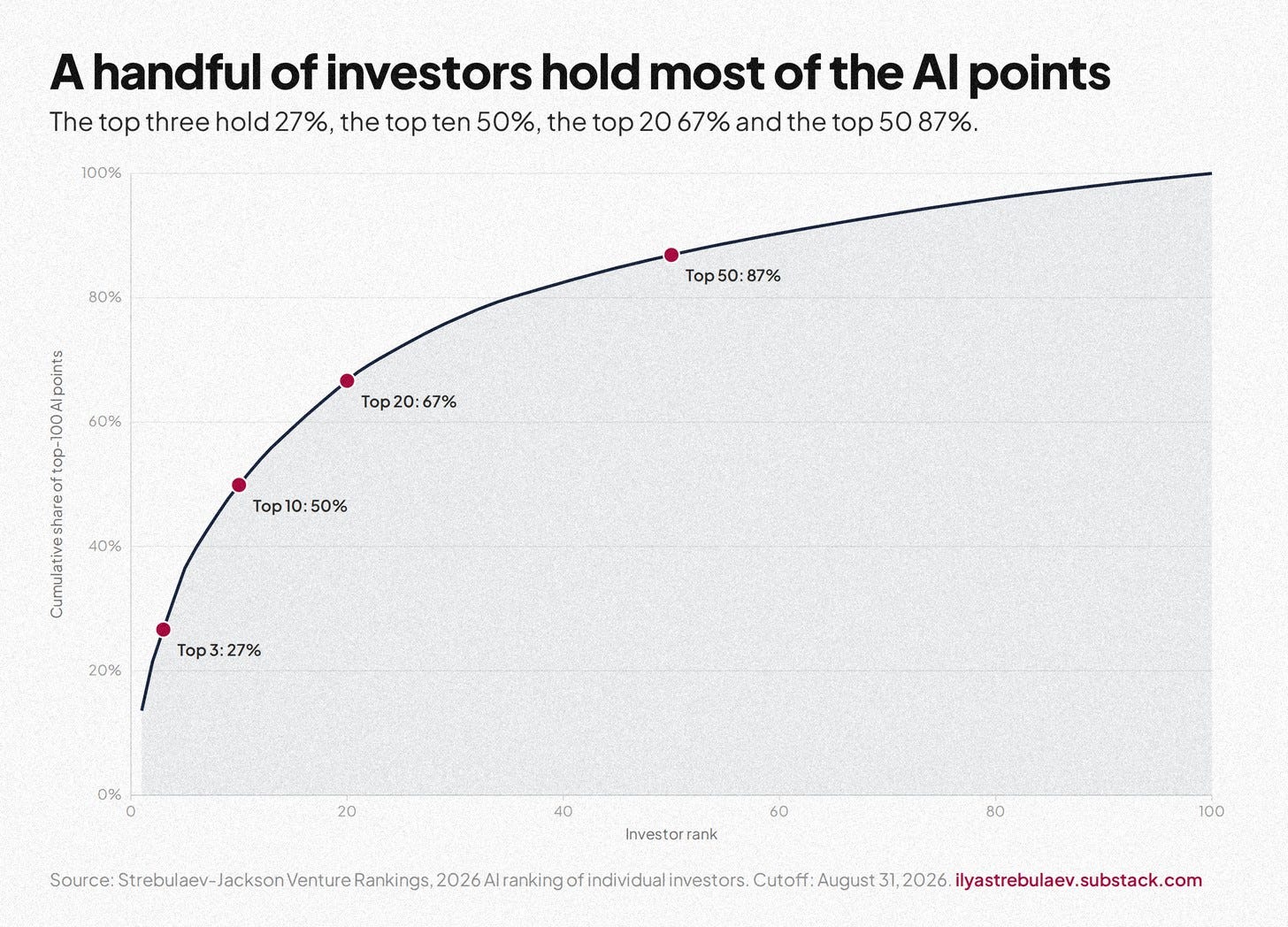
Figure 2
The top ten are good at AI in different ways
The top ten investors share a large AI score, but they got there in different ways. Here is a short profile of each.
1. Matthew Murphy, Menlo Ventures (12,108 points). All of Murphy’s AI points come from investments made since 2023, and AI accounts for 98% of his total score. His AI points equal 90% of Menlo’s AI score as a firm.
2. Guru Chahal, Lightspeed Venture Partners (7,017). Over 99% of Chahal’s AI points come from investments made since 2023, and AI accounts for 99% of his total score. His points equal about half of Lightspeed’s AI score.
3. Ben Horowitz, Andreessen Horowitz (4,596). Horowitz has the most spread-out AI record in the top ten, with 17% of his AI points from investments made before 2015, 53% from 2015–2019 and 23% from 2023 onward. AI accounts for 99% of his total score.
4. Joshua Kushner, Thrive Capital (4,448). All of Kushner’s AI points come from investments made since 2023. AI accounts for 80% of his total score, and his points equal 56% of Thrive’s AI score.
5. David George, Andreessen Horowitz (4,369). George leads a16z’s growth investing. He earns 70% of his AI points from investments made since 2023 and 25% from 2015–2019. AI accounts for 93% of his total score.
6. Sarah Wang, Andreessen Horowitz (2,816). Wang started in venture capital in 2019. All of her AI points come from investments made since 2023, and AI accounts for her entire score.
7. Marc Stad, Dragoneer (2,475). All of Stad’s AI points come from investments made since 2023, and AI accounts for his entire score.
8. Patrick Grady, Sequoia (2,360). Grady’s AI points split almost evenly between two eras, 47% from 2015–2019 and 53% from 2023 onward. AI accounts for 72% of his total score.
9. Eric Vishria, Benchmark (2,276). Vishria earns 72% of his AI points from investments made since 2023 and 23% from 2015–2019. AI accounts for 87% of his total score, and his points equal 62% of Benchmark’s AI score.
10. Sol Bier, Factorial Funds (1,955). Bier started in venture capital in 2020, the most recent start in the top ten. All of his AI points come from investments made since 2023, AI accounts for his entire score, and his points equal 89% of Factorial’s AI score.
Three of the top ten work at Andreessen Horowitz. Six of the ten earn at least 99% of their AI points from investments made since 2023.
Three companies anchor two-fifths of the ranking
For each investor, we identify the single highest-scoring AI investment. Across the top 100, there are 38 distinct such companies. Anthropic is the highest-scoring AI investment for 20 investors. OpenAI is the highest-scoring investment for 12, and xAI for 9. Together, these three companies anchor 41 of the top 100. Databricks follows with 6, and Anduril Industries and Baseten with 4 each (Figure 3).
OpenAI matters much more for individuals than for firms. It is the top AI investment for 12 of the top 100 investors but for only 4 of the top 100 firms. Its backers in the top 100 include both investors who came in during 2015–2019, whose positions still dominate their scores after decay, and investors who came in since 2023.
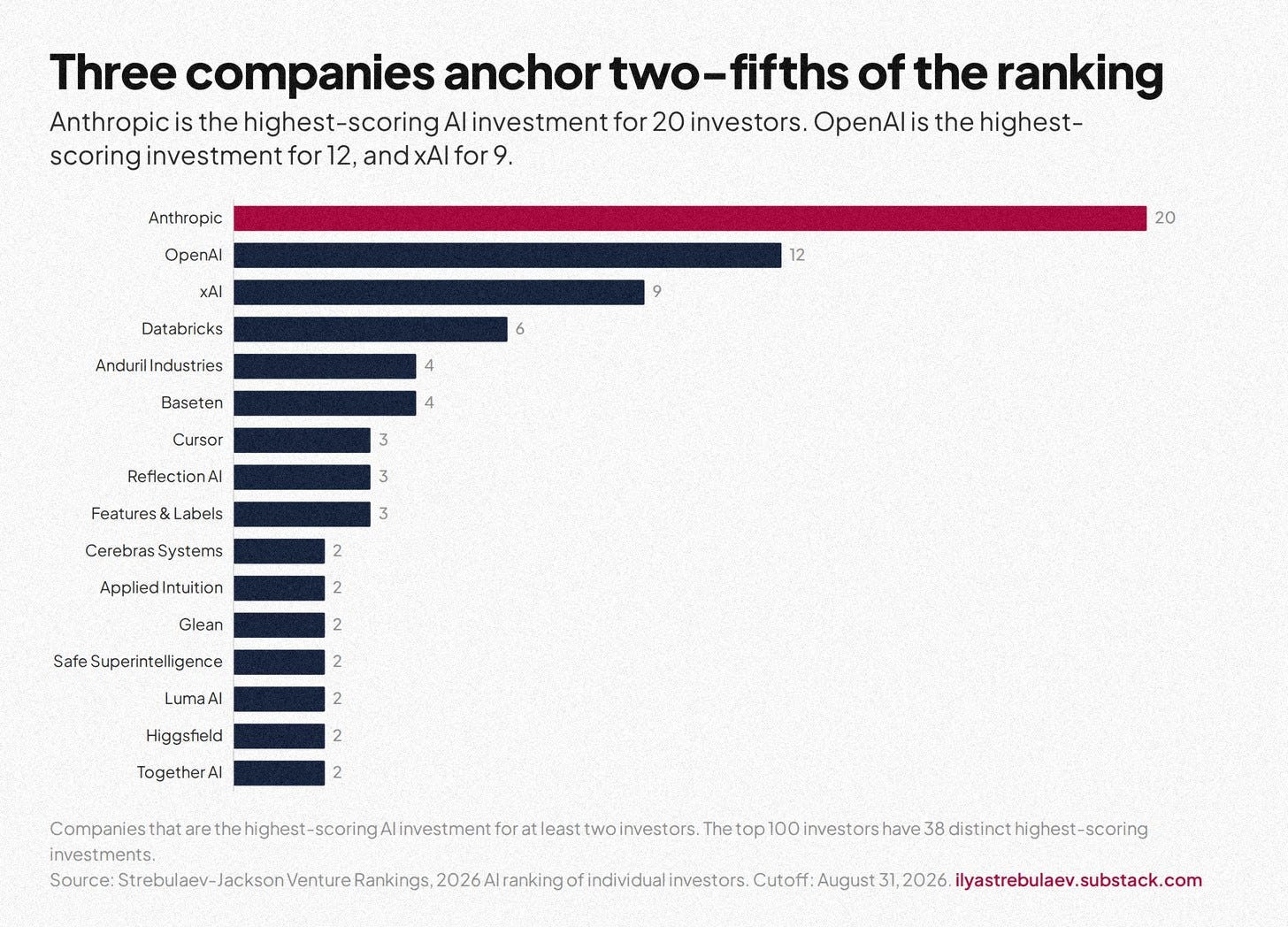
Figure 3
Most AI points come from investments made since 2023
Across the top 100 investors, 73% of all points come from investments made in 2023 or later (Figure 4). For the median investor, the share is 97%. Fifty-seven investors earn at least 90% of their AI points from these recent investments.
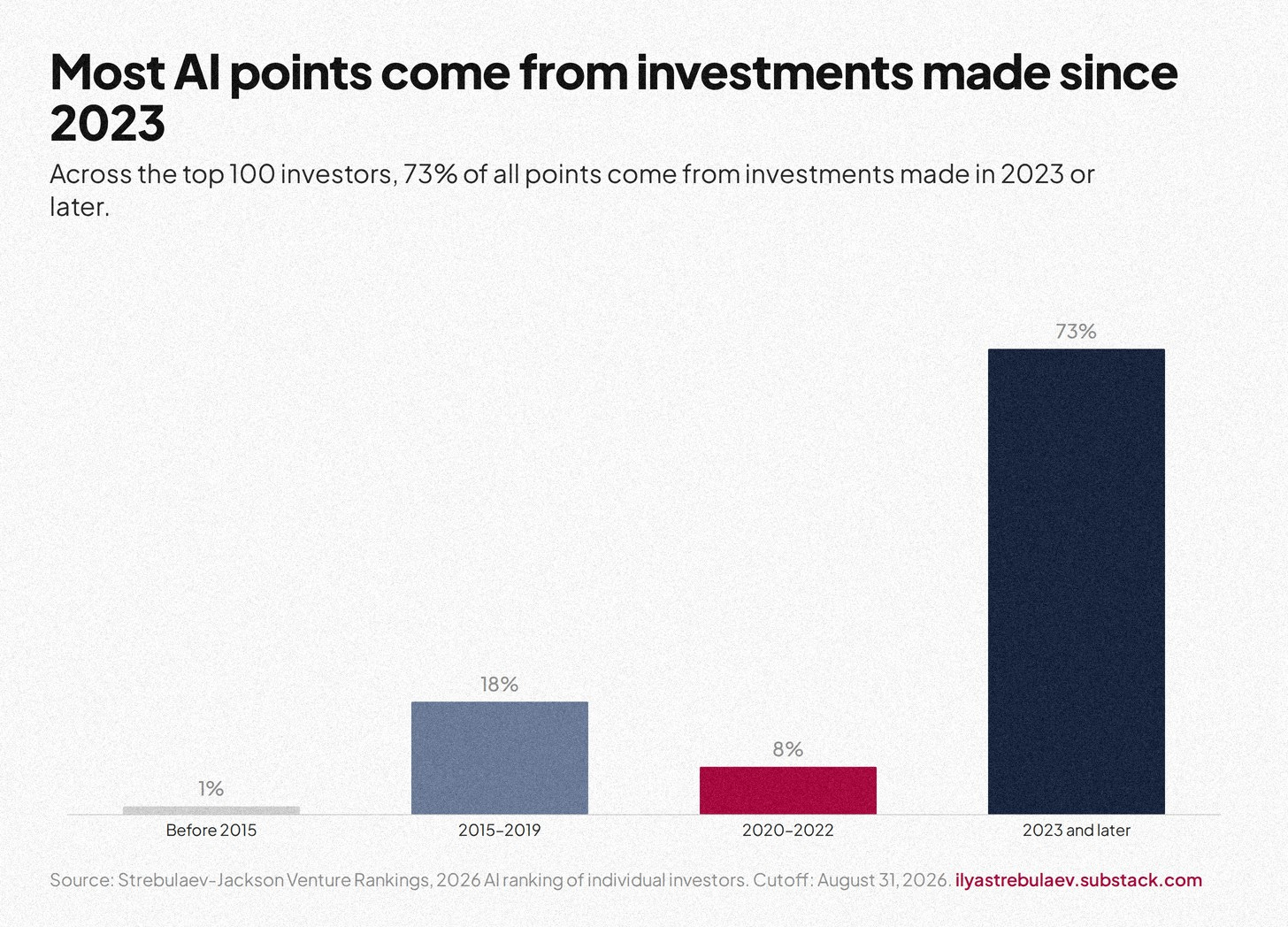
Figure 4
The 2020–2022 boom vintage again barely registers
As with firms, investments made in 2020–2022 contribute little, 8% of all points. Investments made in 2015–2019 contribute 18%, even though they are older and so more heavily discounted.
Figure 5 shows the vintage mix for each of the top 20 investors. Most of the bars are almost entirely recent.
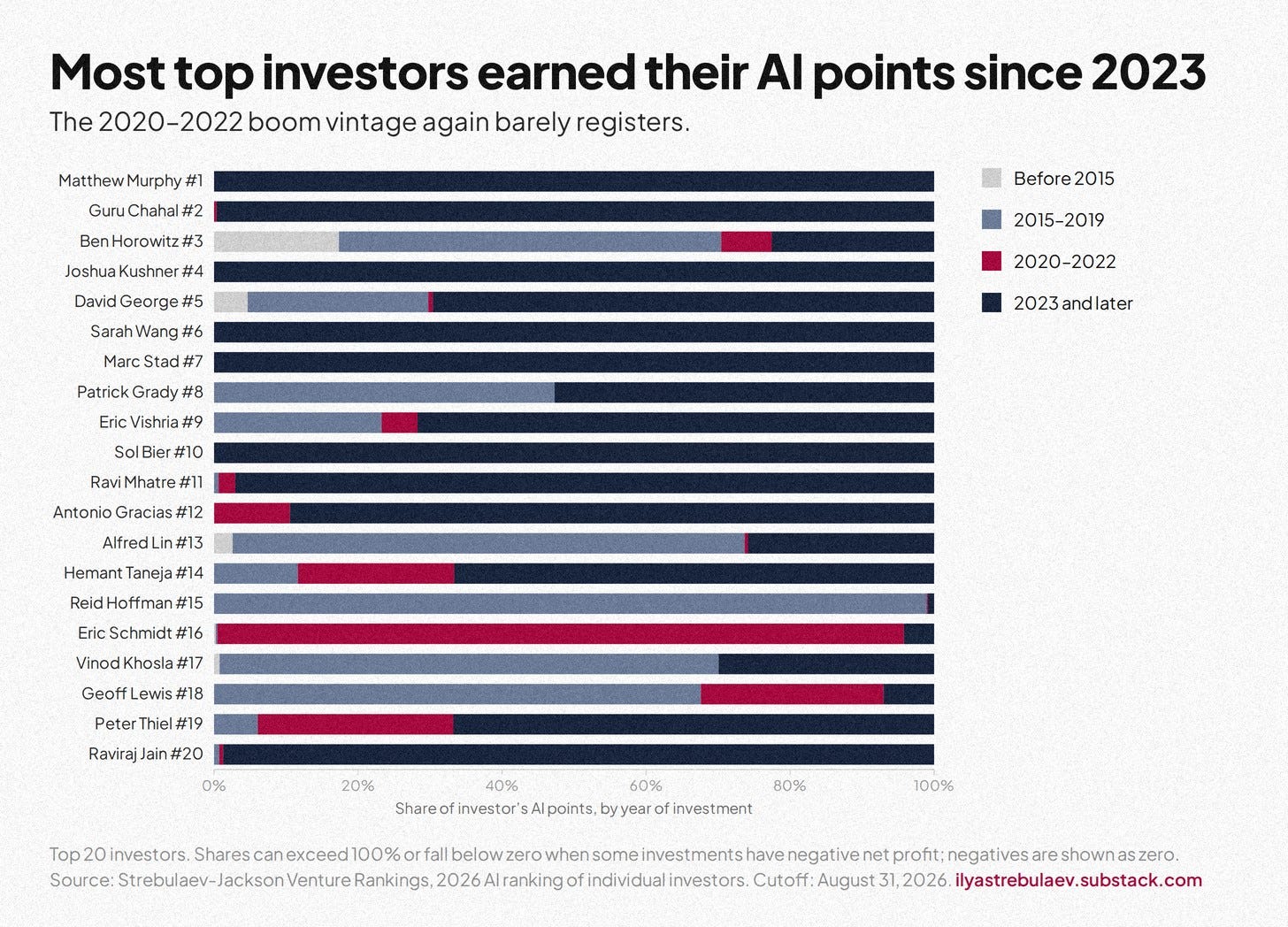
Figure 5
Some top investors built their AI positions early
Thirteen investors in the top 100 earn 10% or less of their AI points from investments made since 2023. They fall into two groups.
The first group invested in AI mainly in 2015–2019. Reid Hoffman (Greylock) earns 99% of his AI points from that period. Sven Strohband (Khosla Ventures) and Alex Immerman (Andreessen Horowitz) earn almost all of theirs from it, Michelangelo Volpi (Hanabi Capital) and Ashvin Bachireddy (SV Angel) 97%, Dharmesh Thakker (Battery Ventures) and Lior Susan (Eclipse Capital) 89%, Peter Sonsini (Laude Ventures) 76% and Geoff Lewis (Bedrock) 68%.
The second group built its AI positions mainly during the 2020–2022 boom. Eric Schmidt (Innovation Endeavors) earns 95% of his AI points from that period, Ashu Garg (Foundation Capital) and Sarah Catanzaro (Amplify Partners) 92% and David Ulevitch (Andreessen Horowitz) 58%.
These investors backed AI companies before the current wave, and those positions still score despite heavy decay (Figure 6).
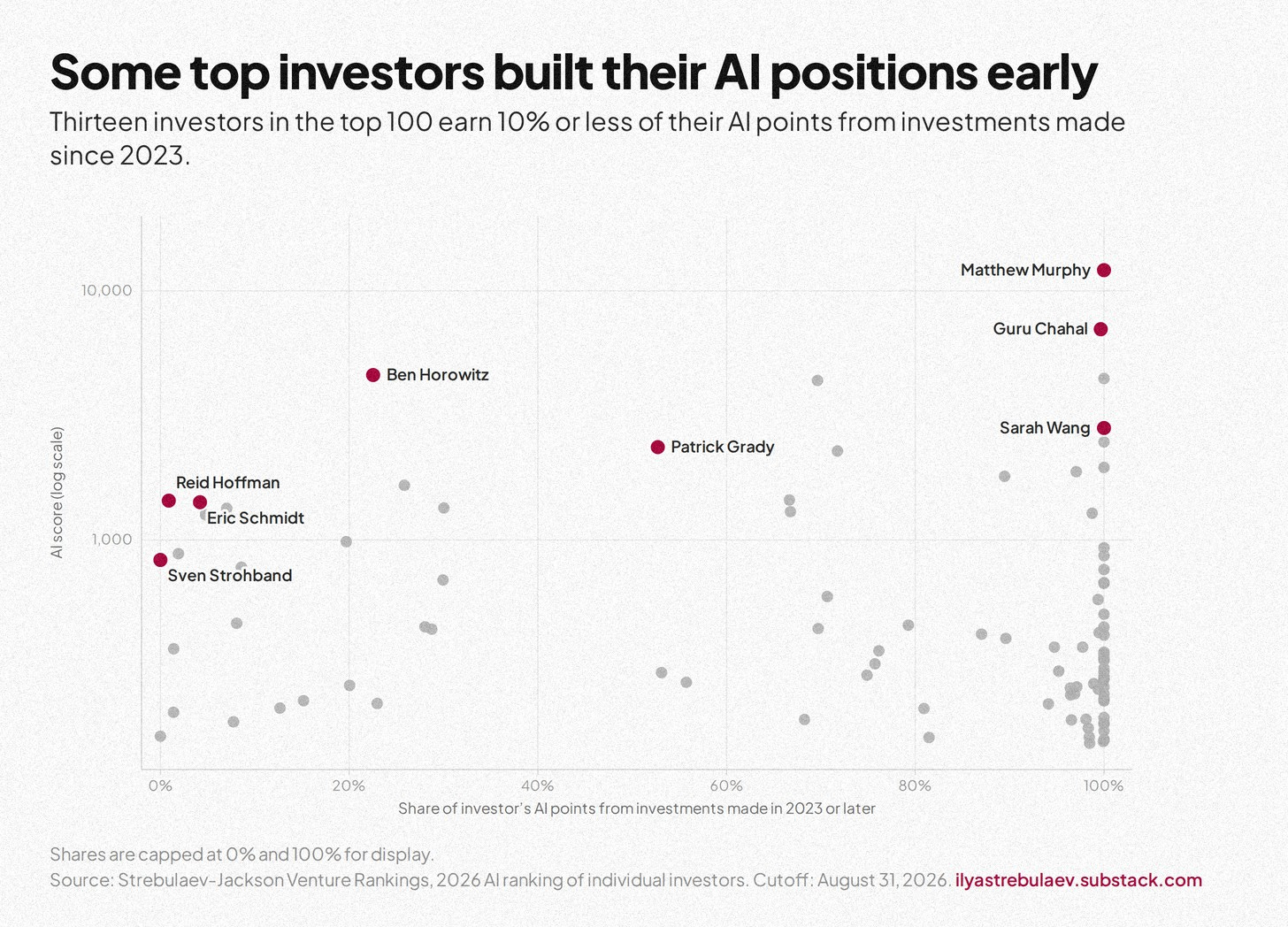
Figure 6
Top AI investors are far more specialized than their firms
For each investor, we also compute the share of the investor’s total score, across all sectors and at the same cutoff, that comes from AI. The median top-100 firm earns 48% of its total score from AI. The median top-100 investor earns 85% (Figure 7).
Forty-two investors earn more than 90% of their total score from AI. For 12 of them, AI accounts for their entire score or more. As with firms, a share above 100% means that the investor’s non-AI investments have negative net profit.
Only three investors in the top 100 earn less than 20% of their score from AI: Jeffrey Jordan of Andreessen Horowitz (7%), Shardul Shah of Index Ventures (14%) and Michelangelo Volpi of Hanabi Capital (17%). Several well-known investors also earn less than half of their score from AI, including Peter Thiel (36%), Alfred Lin (37%) and Mamoon Hamid (33%).
This pattern makes sense. VC firms are often diversified across sectors. Within a firm, however, AI points concentrate in the partners who focus on AI.
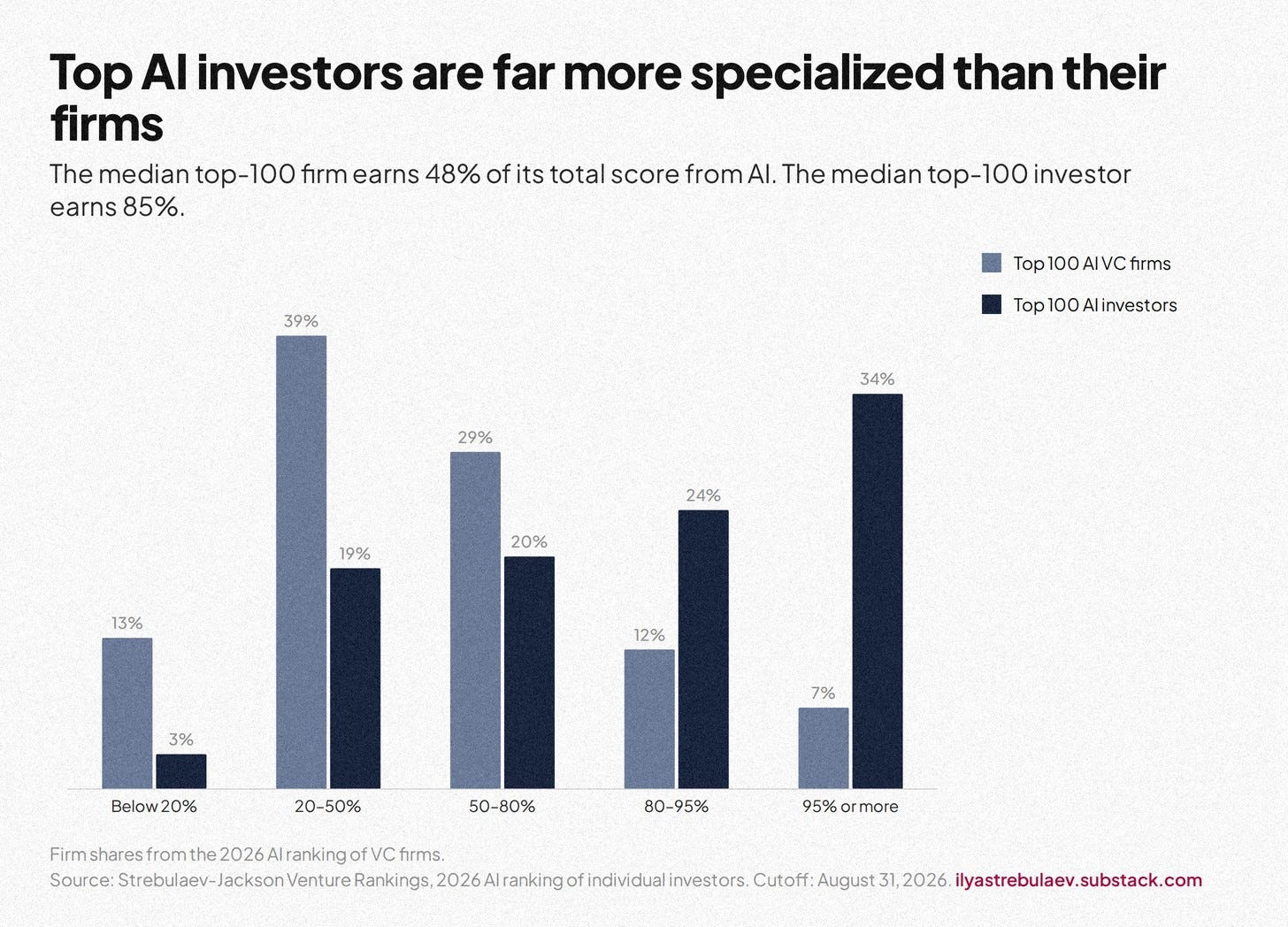
Figure 7
The top AI investors cluster in a few firms
The top 100 AI investors work at 62 firms, and 45 of those firms have exactly one. Andreessen Horowitz employs 11 of the top 100. Lightspeed Venture Partners and Sequoia employ 6 each. These three firms employ 23 of the top 100. General Catalyst, Greylock, Kleiner Perkins and Spark Capital employ 3 each (Figure 8).
At the other end, several top firms have no investor in the individual top 100. They include ICONIQ Growth (5th in the firm ranking), Tiger Global (10th) and Coatue (11th).
Fourteen of the top 100 investors work at firms outside the top 100 AI VC firms: Geoff Lewis (Bedrock), Peter Sonsini (Laude Ventures), Ashton Kutcher (Decimal Capital), Kevin Jiang (Mangusta Capital), Jana Messerschmidt (#ANGELS), Landon Downs (Cambium), Lip-Bu Tan (Celesta), Robert Nelsen (ARCH Venture Partners), Raymond Tonsing (Caffeinated Capital), Zavain Dar (Dimension), Jeffrey Herbst (GFT Ventures), Michelangelo Volpi (Hanabi Capital), Max Gazor (Striker Venture Partners) and Mary D’Onofrio (Crosslink). Some of these firms are small or new, and some of these investors made their AI investments at previous firms.
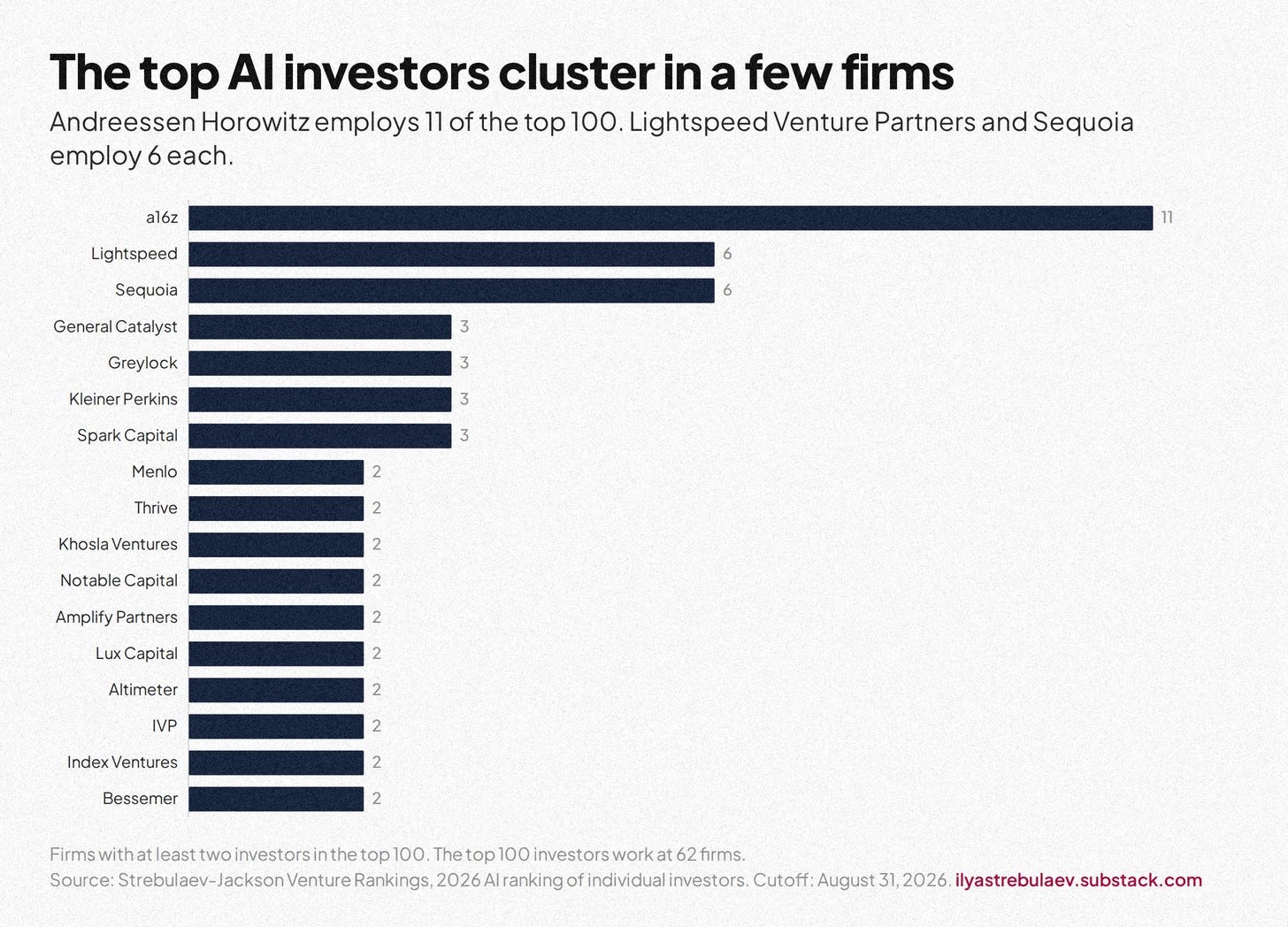
Figure 8
At some firms, one investor carries the AI score
Comparing individual and firm scores shows how concentrated AI success is inside firms. Matthew Murphy’s points equal 90% of Menlo Ventures’ AI score. Sol Bier’s equal 89% of Factorial Funds’. Reid Hoffman’s equal 64% of Greylock’s, Eric Vishria’s 62% of Benchmark’s, Joshua Kushner’s 56% of Thrive Capital’s and Guru Chahal’s 49% of Lightspeed’s (Figure 9).
Andreessen Horowitz is the opposite case. Its highest-ranked investor, Ben Horowitz, accounts for about a fifth of the firm’s AI score. Its 11 investors in the top 100 together account for nearly three-quarters. Sequoia looks similar, with its top investor accounting for 22% of the firm’s AI score.
These shares are approximate. An investor’s score can include investments made at a previous firm, and a firm’s score can include credit from partners who have left. But the pattern is clear. Some firms’ AI records rest on one person, while others are spread across a deep team.
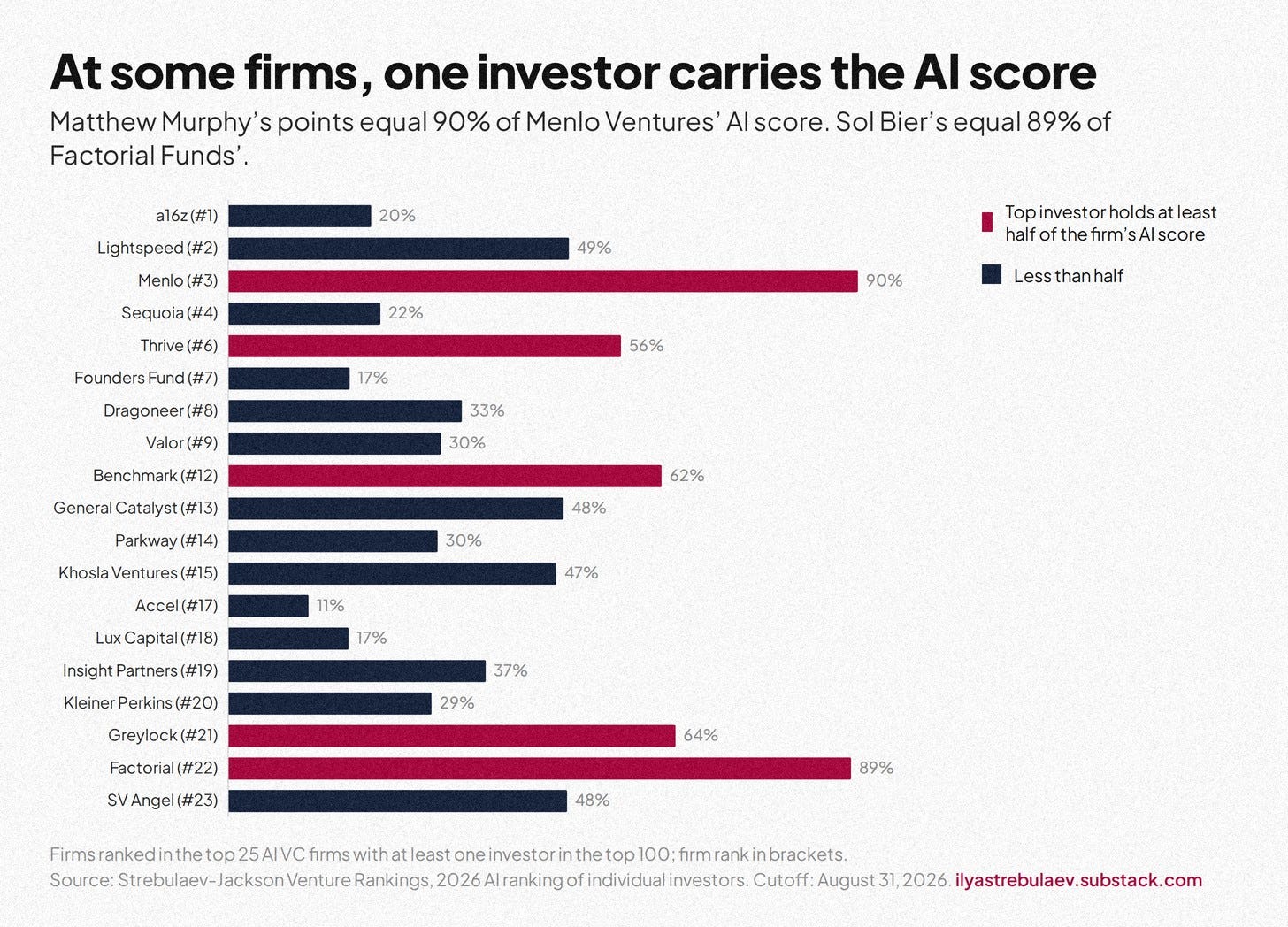
Figure 9
Experience does not predict AI rank
The top 100 investors started in venture capital across five decades. The median investor started in 2010. John Doerr (Kleiner Perkins) started in 1980, and Vinod Khosla in 1986. At the other end, Sarah Wang started in 2019 and ranks sixth, and Sol Bier started in 2020 and ranks tenth. Sebastian Duesterhoeft and Lisa Han, both at Lightspeed, started in 2022.
Across the top 100, there is almost no relationship between when an investor started and how high they rank (Figure 10). In AI, a new partner with access to the right companies can outrank a veteran with decades of experience.
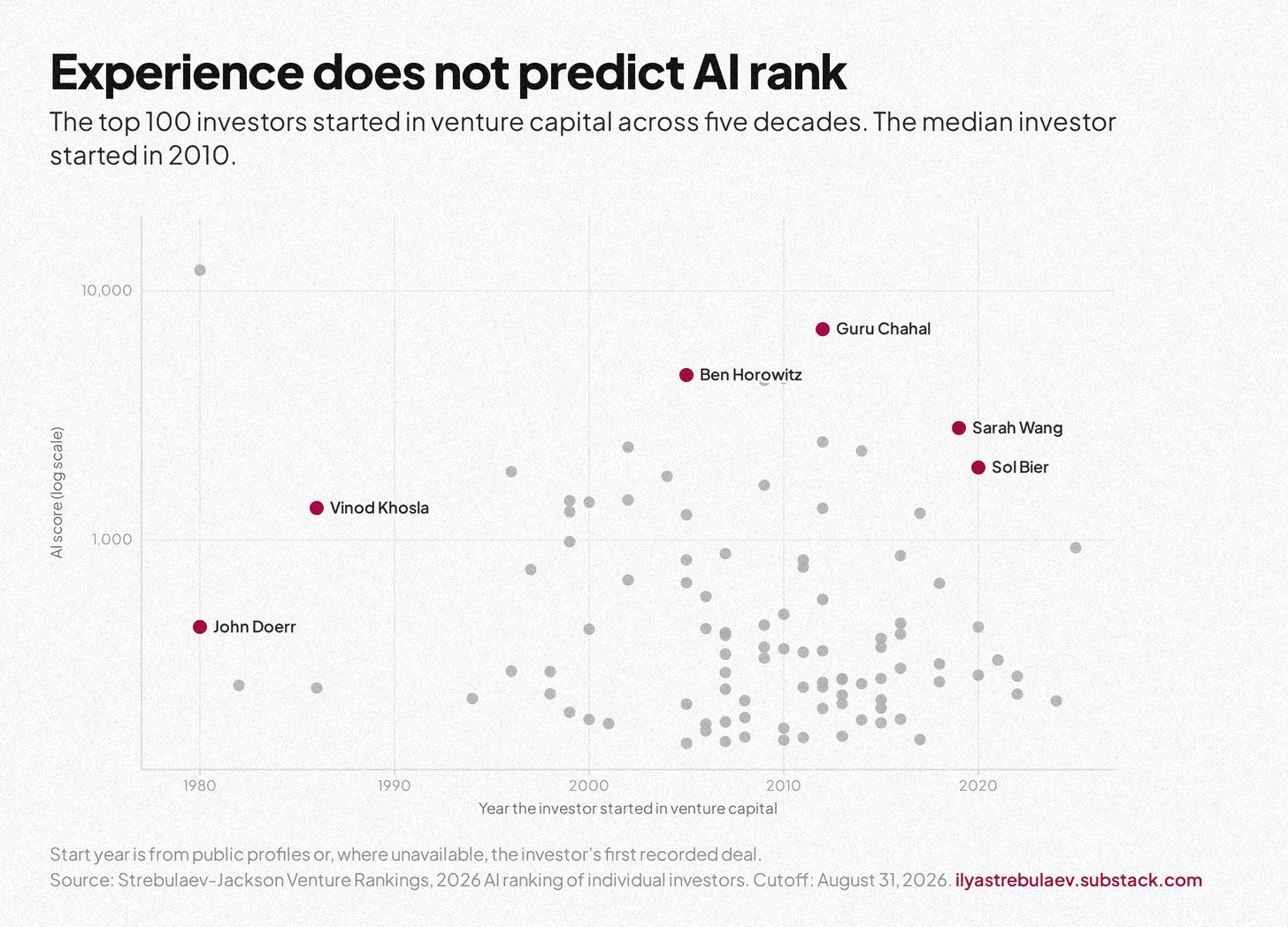
Figure 10
Menlo Park and San Francisco dominate
Seventy-six of the top 100 investors work at firms headquartered in the San Francisco Bay Area: 37 at firms in Menlo Park, 25 in San Francisco and 9 in Palo Alto. See Figure 11.
New York-headquartered firms employ 9 of the top 100. Two investors work at Index Ventures, which is headquartered in London but has a large San Francisco office.
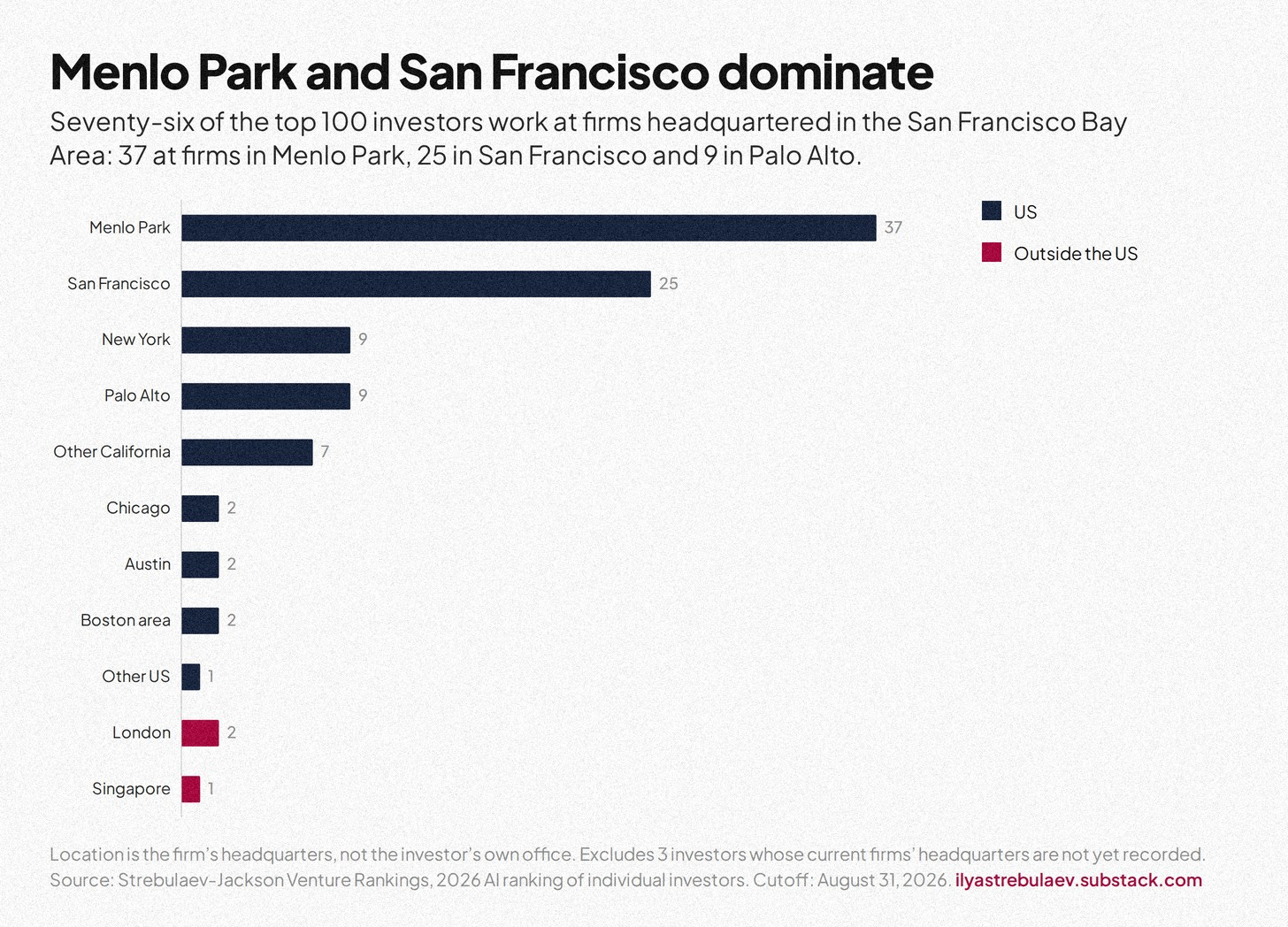
Figure 11
What this means for founders and LPs
For founders
Look at the person, not only the logo. At many firms, one or two partners account for most of the AI track record. Ask who will lead your round and sit on your board, and look at that person’s record.
Check how recent the record is. Most top AI investors earned their points in the past three years. A few built their positions years earlier. Both are valuable, but they say different things about an investor’s current access and judgment.
Do not dismiss newer investors. Experience does not predict AI rank. Some of the highest-ranked investors started in venture capital only a few years ago.
For limited partners
Watch for key-person risk. When one investor’s points equal most of a firm’s AI score, the firm’s AI record depends on that person staying.
Look inside the firm. A firm’s AI score can rest on one star or on a deep bench. The individual ranking shows which.
Remember that most AI value is unrealized. Most points come from investments made since 2023, mostly in companies that are still private. We discount private valuations, but the marks can still move a lot in either direction.
Our ranking caveats
Every ranking has limits. Here are the ones I think matter most for this one.
Attributing deals to individuals is hard. Public data often do not say which partner led an investment. We combine several sources and check the most important cases by hand, but some attributions will be wrong or missing.
People move and change roles. Some investors in the top 100 have moved firms, stepped back or taken operating roles. We show each investor at their firm as of the cutoff.
Most of the value is unrealized and recent. The ranking measures value created to date, mostly in private companies whose valuations can change quickly.
A few companies drive much of the ranking. Anthropic, OpenAI and xAI are the highest-scoring AI investments for 41 of the top 100 investors. A large change in their value would move many investors at once.
Classification involves judgment. We apply our AI classification consistently, but some cases are grey and experts may disagree.
Data is not perfect. VC data is notoriously opaque. Although I have spent years improving it, there is always room for improvement.
The 2026 AI ranking: the top 200 investors
The full analysis, including ranks 101 to 200 and an interactive Airtable with the data behind every score, is available to Paid members.
